Six specialists. One record. Forty-one endpoints.

You talk to one AI counsel. Behind it, six specialist agents work the same company record through forty-one legal workflows — and stop, on purpose, wherever judgment belongs to a licensed attorney.

What an agent is

A chatbot answers. An agent finishes.

A chatbot takes your question and returns text. It knows nothing about your entity, holds nothing after the tab closes, and leaves the actual work — the approval, the signature, the filing, the ledger — exactly where it was.

A FinePrint agent reads the company record before it acts, runs the whole transaction, and writes the result back. That is the entire difference, and it is the reason the second matter is faster than the first: the record it wrote yesterday is the record it reads today.

Every run is bounded. The endpoint decides which facts are required, which approvals are needed, and which conditions send the matter to a lawyer. The agent doesn’t get to reason its way past any of them.

Northwind Robotics and every counterparty named on this page are fictional, used to show a real workflow.

  • It reads first

    Before a word is drafted, the agent resolves the facts it needs out of the Company Legal Graph — entity, authority, cap table, existing agreements, the states you employ in. Missing facts stop the run and get asked for by name. Nothing is assumed.

  • It runs the whole transaction

    Documents, the approval that makes them valid, the signature order, the government filing, the fee, the receipt. An endpoint is finished when the paperwork is executed and filed — not when a draft appears.

  • It writes back

    Executed documents land in the Legal DataRoom. The graph moves — headcount, pool, ownership, obligations. New deadlines appear in Today. Current by construction, because the write-back is part of the endpoint, not a chore afterwards.

  • It knows when to stop

    Every endpoint carries the conditions that make a matter Yellow or Red. When one trips, the agent assembles the file and hands it to a licensed attorney with the scope on screen — before anything moves, and no fee attached.

Six specialists, each deep in one lane.

A general-purpose assistant is shallow everywhere. Each FinePrint agent carries its own playbooks, its own jurisdiction rules, and its own escalation conditions — and reads the same single record as the other five, so the equity math and the employment math never disagree.

01

Commercial

Paper in and paper out. Your NDAs, MSAs, order forms and data-processing terms, plus every counterparty agreement read against your playbook before you sign it. Owns the renewal and notice windows.

/create-nda/review-contract/create-msa/renew-agreement

02

Employment & HR

Hiring, classification, policy and separation — resolved for the state the person actually sits in, not the state you incorporated in. Owns the handbook and the offer set.

/hire-employee/engage-contractor/terminate-employment/update-handbook

03

Corporate

The entity itself: formation, the board, the cap table, the raise. Every resolution traced to the authority that permits it, and every share movement reconciled to the ledger.

/incorporate/create-board-consent/grant-options/issue-safe

04

Privacy, data & AI

The promises you make about data and the ones your contracts make for you. Notices rebuilt from what you actually collect, processing terms, transfer mechanisms, subprocessors kept current.

/create-dpa/publish-privacy-policy/review-contract

05

IP & brand

What you own, and whether you can prove it. The chain of title closed across founders, employees, contractors and any predecessor entity — then the registrations on top of it.

/assign-ip/file-trademark/file-provisional-patent/license-ip

06

Compliance & risk

The recurring obligations nobody is assigned to remember. Annual reports, registered agents, franchise tax, state qualifications and payroll registrations — watched across every entity and every state.

/annual-compliance/foreign-qualify/file-franchise-tax

Categories organize the catalogue; specialists own the judgment. More than one agent can work a single matter — a hire touches Employment, Corporate and Compliance in one run — and they coordinate through the record rather than through a conversation. Here is what each one reads, and the line it will not cross.

SpecialistThe record it reads firstWhere it stops, and a lawyer takes it
Commercial Your position playbook, the counterparty’s agreement history, entity and signing authority, insurance limits, the obligations already live in other contracts. Uncapped or unusual liability, an indemnity outside the playbook, a customer’s paper that rewrites your IP terms, or anything that would bind a company you don’t control.
Employment & HR Headcount by state, the plan and pool, the handbook version in force, existing classifications and the reasoning recorded with them. A restrictive covenant from a prior employer, a classification that isn’t clean on the facts, a termination with a complaint behind it, or a reduction in force.
Corporate Charter and bylaws, board composition and authority, the cap table and ledger, the current 409A, every prior consent and its date. A priced round, a charter amendment that touches preferences, anything with a conflicted director, or a transaction that changes control.
Privacy, data & AI What the product actually collects, the subprocessor list, existing DPAs and transfer mechanisms, the promises already published. A cross-border transfer with no clean mechanism, a regulator’s inquiry, a suspected incident, or a data use your published notice doesn’t cover.
IP & brand Assignment coverage per contributor, filings and their status, prior art and search results already on file, license grants in and out. A gap in the chain of title, a conflicting mark, a demand letter, or a license whose scope decides how you can sell the product.
Compliance & risk Entity registrations by jurisdiction, filing calendar and history, agent of record, payroll and tax accounts, receipts in the Legal DataRoom. A missed filing with penalties accruing, a lapsed or revoked registration, a notice from a state agency, or an audit.

Forty-one endpoints, counted.

An endpoint is not a template and not an answer. It is the whole transaction: the documents, the approvals, the signatures, the filings, and the record updated after. Here is every one of them.

Formation4

Incorporation, founder stock, first filings

/incorporate/issue-founder-stock/file-83b/obtain-ein
Governance6

Board consents, minutes, approvals

/create-board-consent/hold-board-meeting/appoint-director/appoint-officer/amend-charter/authorize-shares
Hiring6

Offers, agreements, contractor terms

/hire-employee/engage-contractor/convert-contractor/appoint-advisor/terminate-employment/update-handbook
Equity6

Option grants, plans, 409A

/grant-options/exercise-options/adopt-equity-plan/order-409a/amend-grant/repurchase-shares
Fundraising5

SAFEs, notes, data rooms

/issue-safe/issue-convertible-note/close-priced-round/prepare-data-room/file-form-d
Commercial6

NDAs, MSAs, DPAs, reviews

/create-nda/review-contract/create-msa/create-sow/create-dpa/renew-agreement
IP4

Assignments, trademarks, licensing

/assign-ip/file-trademark/file-provisional-patent/license-ip
Compliance4

Filings, registrations, deadlines

/annual-compliance/foreign-qualify/file-franchise-tax/publish-privacy-policy

Four plus six plus six plus six plus five plus six plus four plus four. The catalogue below is the same forty-one, written out, so you can check the arithmetic yourself.

EndpointNameWhat it runs, end to end
Formation · 4
/incorporateIncorporate the companyCharter, bylaws, initial board consent, share authorization, founder ledger opened, filing receipt to the Legal DataRoom.
/issue-founder-stockIssue founder stockRestricted stock purchase agreements, vesting schedules, consideration recorded, certificates issued and reconciled to the ledger.
/file-83bFile the 83(b) electionElection prepared, mailed with tracked delivery, receipt filed, the thirty-day clock watched from the day of purchase.
/obtain-einObtain the federal EINSS-4 prepared and filed, EIN written to the record so every downstream filing and payroll registration inherits it.
Governance · 6
/create-board-consentBoard written consentResolutions drafted from the record, routed in signing order, countersigned, minuted, and attached to whatever they authorize.
/hold-board-meetingHold a board meetingNotice, agenda and resolutions prepared in advance; minutes drafted from what was actually approved and adopted at the next meeting.
/appoint-directorAppoint or remove a directorConsent, acceptance, indemnification agreement, board composition and authority updated everywhere the record uses it.
/appoint-officerAppoint an officerResolution, title and signing authority written into the record — so later endpoints know who is permitted to sign what.
/amend-charterAmend the certificate of incorporationBoard and stockholder approvals assembled, certificate of amendment filed, restated charter indexed as the operative document.
/authorize-sharesIncrease authorized sharesThe arithmetic checked against the cap table and the pool, approvals gathered, amendment filed, pool availability rewritten.
Hiring · 6
/hire-employeeHire an employeeSeven documents, the board consent for the grant, state registrations and filings, record and calendar updated. Broken apart below.
/engage-contractorEngage a contractorAgreement and statement of work, IP assignment, and a classification test recorded with the reasoning that produced it.
/convert-contractorConvert a contractor to an employeePrior IP chain closed out, offer set issued, classification history preserved so the transition is defensible later.
/appoint-advisorAppoint an advisorAdvisor agreement, board-approved grant, vesting and any cliff placed on the calendar with the grant documents attached.
/terminate-employmentEnd an employmentFinal-pay rules for the employee’s state, separation and release documents, equity treated per the plan, access and accounts closed.
/update-handbookUpdate the handbookThe policy set rebuilt for every state you employ in, addenda generated, acknowledgments collected and stored against each employee.
Equity · 6
/grant-optionsGrant optionsGrant notice and award agreement, board approval, strike checked against the current 409A, pool math written back to the record.
/exercise-optionsExercise optionsNotice of exercise, payment and withholding, share issuance, ledger and cap table corrected on the same day.
/adopt-equity-planAdopt or amend an equity planPlan document, board and stockholder approvals, reserve set, and every existing grant re-checked against the new terms.
/order-409aCommission a 409A valuationInputs assembled from the record, report filed, new strike price applied and the valuation’s expiry placed on the calendar.
/amend-grantAmend a grantRepricing, extension or acceleration — approvals gathered, amended documents issued, tax consequences flagged before you approve.
/repurchase-sharesRepurchase sharesRepurchase notice, board approval, payment and cancellation, ledger and cap table reconciled and the pool returned.
Fundraising · 5
/issue-safeIssue a SAFETerms set against the record, board approval, signature, and pro forma dilution written back so the next grant uses the right numbers.
/issue-convertible-noteIssue a convertible noteNote and purchase agreement, approvals, and maturity, interest and conversion triggers placed on the calendar.
/close-priced-roundClose a priced roundThe closing set assembled, approvals and consents chased, shares issued, post-closing record and calendar rebuilt.
/prepare-data-roomPrepare a data roomA diligence room built from the Legal DataRoom against the standard request list — with the gaps listed before an investor finds them.
/file-form-dFile Form DFederal notice filed on time, state notice filings identified for every investor’s state, receipts returned to the record.
Commercial · 6
/create-ndaIssue an NDAMutual or one-way from the approved position set, signed, indexed to the counterparty, term and expiry on the calendar.
/review-contractReview a counterparty’s contractRead against your playbook, an issue list with your position and its fallback for each one, and a redline you can send.
/create-msaIssue a master services agreementThe master terms and the order-form structure underneath them, drawn from the playbook and bound to your entity.
/create-sowIssue a statement of workScope, fees, deliverables and acceptance, attached to the correct master agreement and inheriting its terms.
/create-dpaIssue or negotiate a DPAProcessing terms, transfer mechanism and subprocessor list, kept consistent with the privacy notice you actually publish.
/renew-agreementRenew, amend or terminateNotice windows watched from the day of signature; the notice drafted and served in time, and the record and calendar updated after.
IP · 4
/assign-ipAssign IP to the companyThe chain of title closed across founders, employees, contractors and any predecessor entity — with the gaps named where they exist.
/file-trademarkFile a trademarkScreening search, class selection, specimen and application filed, and every prosecution deadline placed on the calendar.
/file-provisional-patentFile a provisional patentInventor declarations and assignments, the provisional filed, and the twelve-month conversion clock watched from the filing date.
/license-ipLicense IP in or outGrant scope, field, territory and term set explicitly — plus the obligations that survive termination, written into the record.
Compliance · 4
/annual-complianceRun the annual setAnnual report, registered agent, annual minutes and every recurring obligation the entity owes — filed, paid, receipted.
/foreign-qualifyQualify in a new stateStatement of authority filed, registered agent appointed, payroll and tax accounts registered, and the new state’s calendar started.
/file-franchise-taxFile franchise taxBoth calculation methods run, the cheaper one filed and paid, receipt to the Legal DataRoom, next year’s date already set.
/publish-privacy-policyPublish or update the privacy policyThe notice rebuilt from what the product actually collects, with the disclosures each state requires and a dated version history.
Every plan includes credits, and endpoints draw credits as they run. Attorney review is included in the plan — a matter that needs a lawyer is not billed on top of your subscription. Government fees are passed through at cost. See the plans

Anatomy of one endpoint

One hire. Seven documents. Four registrations.

/hire-employee/create-board-consent/grant-options/foreign-qualify

Northwind Robotics is hiring Sarah Kim, a senior robotics engineer working remotely from Denver — the company’s first Colorado employee. One hire is seven documents, a board written consent, and four Colorado registrations. Here is the run, frame by frame.

01 · Read, then plan

The plan is built from the record, not from a form.

The agent resolves the facts before it decides anything: the option pool has 387,500 shares available, the 409A dated May 12 2026 sets the strike at $0.63, and the board has authority to approve grants by written consent. Colorado is new — the company has no registration there.

Out of those facts comes a plan you can read: seven documents, one board approval, four filings and registrations. Nothing starts until you approve it.

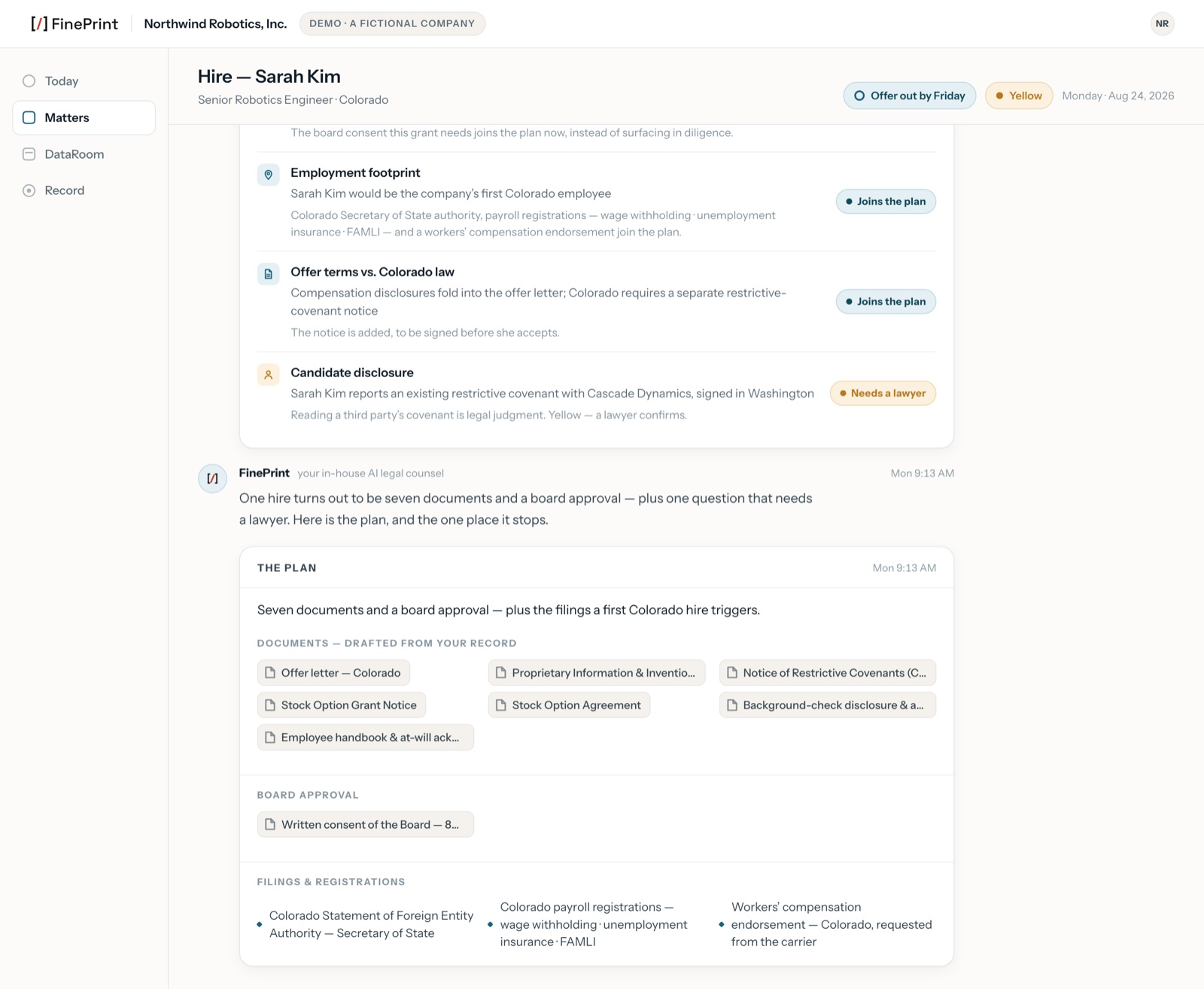
One question can’t be answered from the record — Sarah has a restrictive covenant with a previous employer. That condition makes the matter Yellow before any drafting begins.

“The plan” panel: seven documents to be drafted from the record, one board approval by written consent, and the filings and registrations for a first Colorado employee — Statement of Foreign Entity Authority, payroll registrations for wage withholding, unemployment insurance and FAMLI, and a workers’ compensation endorsement.
The plan, before a word is drafted — seven documents, one board approval, filings and registrations.
02 · Draft and approve

Seven documents, generated from the same facts.

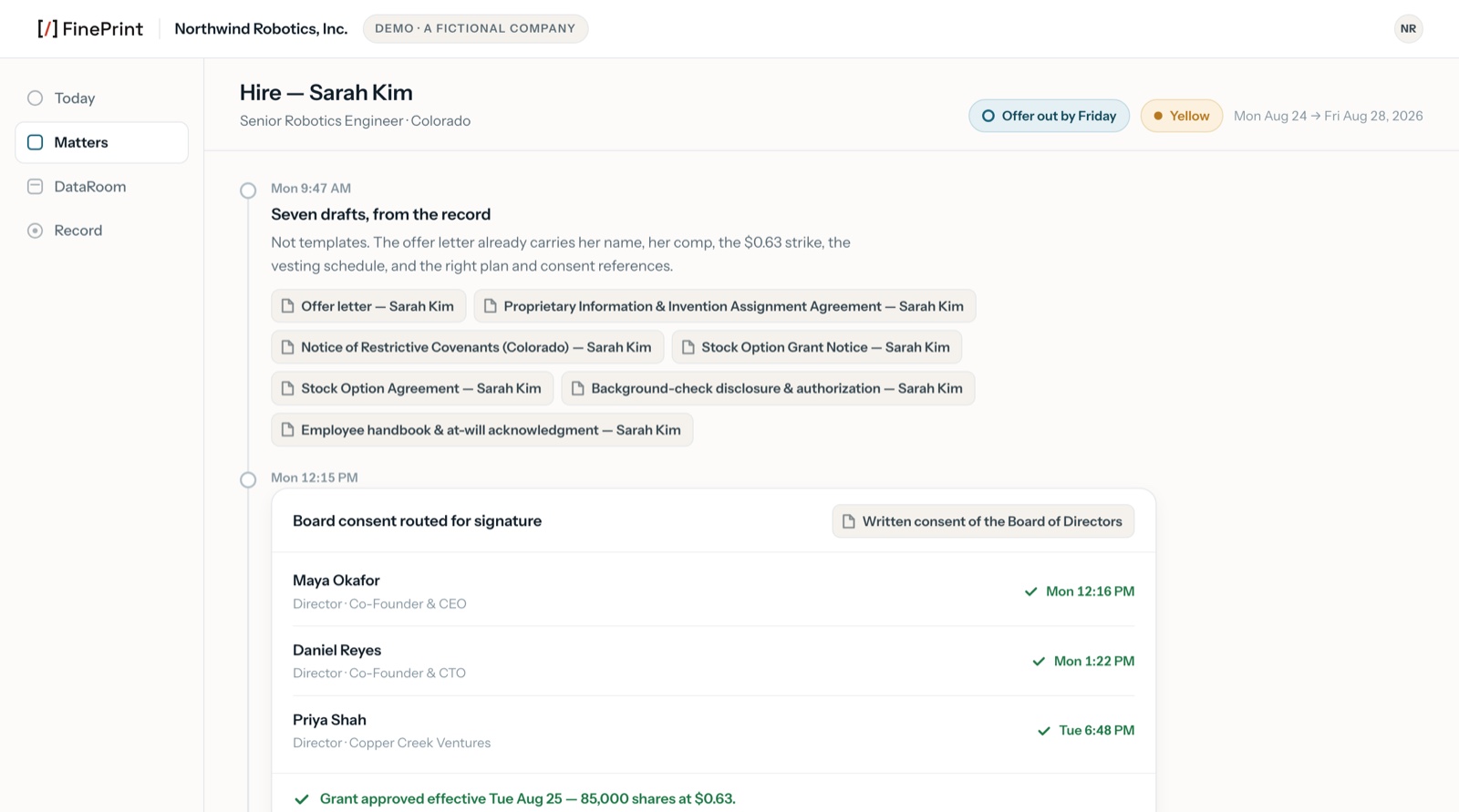
The offer letter, the confidential information and invention assignment agreement, the Colorado restrictive-covenant notice, the at-will and arbitration acknowledgment, the handbook acknowledgment with its Colorado addendum, the option grant notice, and the option award agreement under the plan.

They agree with each other because they were drawn from one record: the same salary, the same 85,000 options at $0.63, the same four-year vest with a one-year cliff, the same September 14 start date. The board written consent that authorizes the grant is routed separately and signed by all three directors.

The Yellow question went to J. Alvarez — employment, Colorado — scope approved Monday 9:31 AM, cleared Wednesday 11:40 AM, at no cost beyond the subscription. A narrow twelve-month customer non-solicit, no bar to the hire, one onboarding guardrail added to the invention assignment.

Seven drafts generated from the company record and listed with their status: offer letter, invention assignment agreement, Colorado restrictive-covenant notice, acknowledgments, and the option grant documents at 85,000 options and a $0.63 strike.
Seven drafts, all from one record — so the cap table and the offer letter cannot disagree.
03 · File, then write back

The filings are the endpoint, not the follow-up.

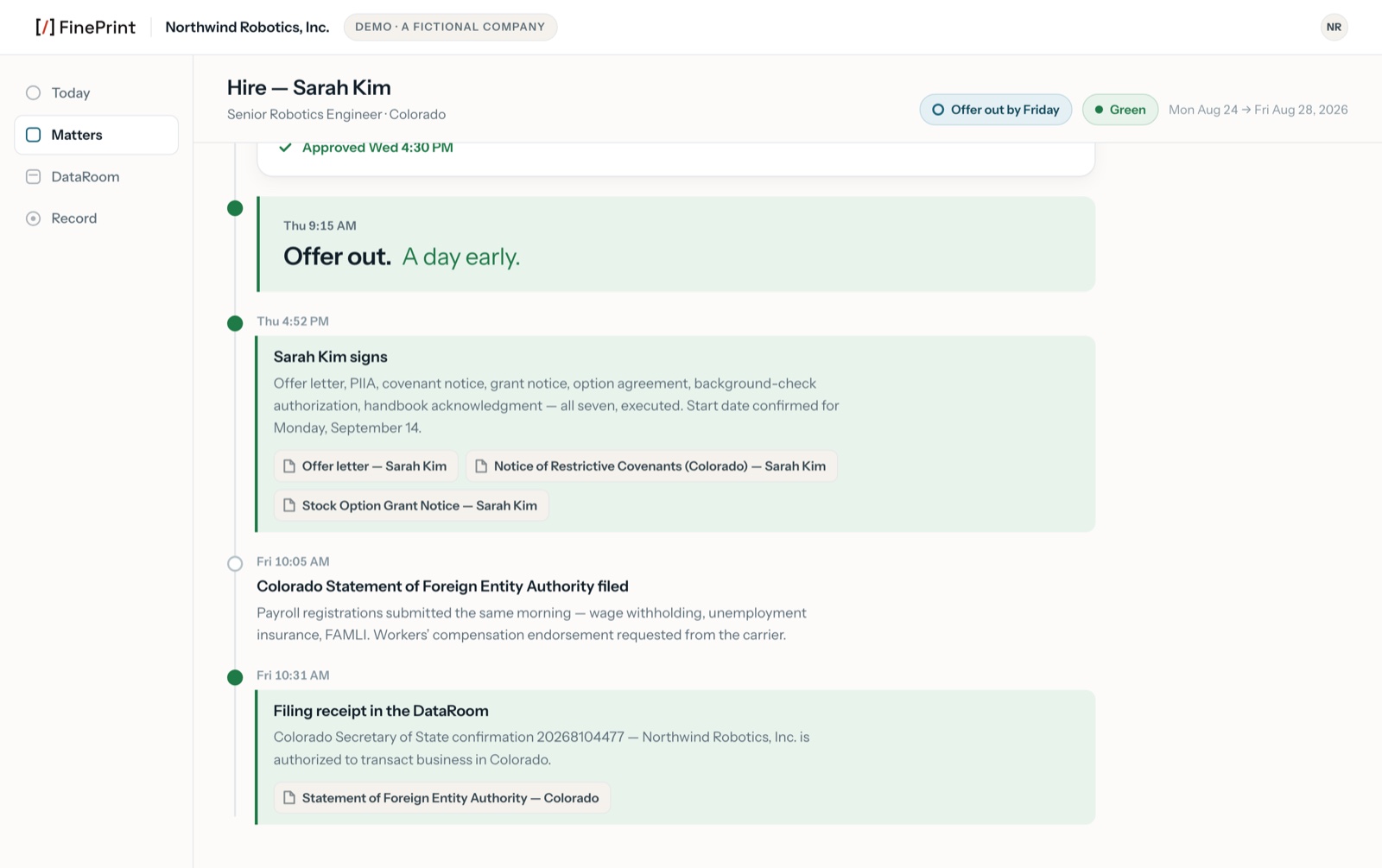
Hiring in Colorado means registering there. The agent runs /foreign-qualify as part of the same matter: the Statement of Foreign Entity Authority with the Colorado Secretary of State, then payroll registrations for wage withholding, unemployment insurance and FAMLI, then the workers’ compensation endorsement.

Each receipt lands in the Legal DataRoom as it arrives. Then the record moves: employees 12 → 13, pool available 387,500 → 302,500, and Colorado’s recurring deadlines start appearing in Today. The offer went out Thursday — a day early.

The filings completing one by one: the Colorado Secretary of State Statement of Foreign Entity Authority, then payroll registrations for wage withholding, unemployment insurance and FAMLI, with each receipt landing in the Legal DataRoom.
Colorado Secretary of State, three payroll registrations, one receipt at a time.
StageWhat the endpoint handles
Facts it gathersName, role, work location and start date · compensation and equity · the pool and its availability · the 409A in force and its expiry · board composition and authority · the states already registered · any restrictive covenant the candidate discloses.
Documents it producesOffer letter · confidential information and invention assignment agreement · Colorado restrictive-covenant notice · at-will and arbitration acknowledgment · handbook and policy acknowledgment with state addendum · option grant notice · option award agreement.
Approval it requiresA board written consent authorizing the grant — resolutions drafted from the plan, routed to all three directors, executed and attached to the grant documents it authorizes.
Filings and registrationsStatement of Foreign Entity Authority (Colorado Secretary of State) · wage withholding account · unemployment insurance account · FAMLI registration · workers’ compensation endorsement.
Where a lawyer entersThe prior restrictive covenant. The attorney and the scope on screen before the attorney starts, with the review included in the plan; the answer and the guardrail it produced stored with the matter.
What it writes backSeven executed documents, the board written consent, and every filing receipt as it lands — all to the Legal DataRoom · employees 12 → 13 · pool available 387,500 → 302,500 · Colorado added to the entity’s registered jurisdictions · quarterly unemployment, FAMLI and annual report dates added to Today.

Where an agent stops.

Every endpoint carries the conditions that decide who touches a matter. The level isn’t a mood — it’s a rule the agent cannot argue with.

Green — agents execute.

Standard work with complete facts runs end to end, with your approval. And the network keeps standing watch: reviewers score the output continuously, so every flag makes the endpoint sharper for every company.

Yellow — a lawyer confirms.

The question is outside what the model has been taught, so the endpoint stops and routes it to the network. A licensed attorney answers it before anything moves, included in your plan — as with Sarah Kim’s restrictive covenant, approved in seventeen minutes and cleared in two days. The answer then joins what OpenLegalLM knows.

Red — a specialist lawyer leads.

A financing, a dispute, a regulated question. The specialist takes the matter with the file already built — the record, the documents, the history and the issue list, assembled before the first call.

The most important thing the system knows is when it doesn’t know. Nothing starts until you approve it, and at every point where judgment matters, the judgment is a licensed attorney’s.

The boundary

What the agents don’t do.

Any system that runs legal work should be as clear about its limits as its capabilities. These are ours, stated plainly, and they are enforced in the product rather than promised in a policy.

  • They don’t give legal advice

    FinePrint is a legal technology company, not a law firm. The agents produce documents, approvals and filings from your record. Where a matter requires legal judgment, a licensed attorney reviews it or takes it — engaged by you, with the scope shown first and the review included in your plan.

  • They don’t decide a judgment call

    An agent can tell you that a term is outside your playbook, what the usual fallback is, and that a lawyer has to decide it. It cannot hold the call itself. When a level trips, the file goes to a person — no override, no confidence threshold that lets it through.

  • They don’t appear before a court or an agency

    No filings on your behalf in a dispute, no representation, no appearances, no negotiation of a matter in litigation. Government filings are ministerial: registrations, reports, notices — the paperwork a company owes, filed on time.

  • They don’t act without your approval

    Nothing is signed, sent, filed or paid until you approve that specific step. The plan is on screen before the run starts, and a matter that brings in a lawyer shows the attorney and the scope before the engagement exists.

  • They don’t train a shared model on your record

    The Two-Corpus Rule: OpenLegalLM learns from its contributors, never from your record. Your documents are retrieved for your matters and are never training material for a shared model. Work that goes to the network for continuous review is anonymized through the Clean Room pipeline first.

  • They don’t fill in what the record doesn’t have

    An endpoint stops when a required fact is missing rather than guessing at it, and it will not run in a jurisdiction whose rules it does not carry. A refusal to proceed is a result, and it is written to the matter with its reason.

Questions people actually ask.

How is this different from asking a general AI assistant the same question?

An assistant answers from general knowledge and forgets you afterwards. An agent reads your company record before it acts — your charter, your board authority, your pool, your existing agreements, the states you employ in — and writes the outcome back to that record when it’s done.

The practical difference is what you hold at the end. An assistant leaves you with text. An endpoint leaves you with executed documents, a filed registration, a receipt, and a company record that now says something different than it did this morning.

What happens when an agent doesn’t know something?

It stops and says so. A missing fact is asked for by name rather than assumed. A condition the endpoint marks Yellow or Red routes the matter to a licensed attorney with the file already assembled, and the attorney and the scope appear on screen before anything moves, with no fee attached.

Do I have to approve every step, or can I let it run?

You approve the plan before the run starts, and you approve any step that signs, sends, files or pays. Between those points the agent works without interruption. Nothing that binds the company or spends money happens on its own.

Who checks the work?

Licensed attorneys in the OpenLegal network, in two modes. Continuous review: Green output is anonymized through the Clean Room pipeline, sampled, scored and flagged — like production code review. Matter review: Yellow and Red matters go to a conflict-checked attorney you engage, with the scope on screen first. Either way it is included in your plan.

Reviewers are paid per review, and their pay is never contingent on approving anything. The application side cannot override a reviewer’s flag.

Can I add an endpoint you don’t have?

The catalogue is forty-one today, and it grows the way the rest of the system does: an attorney in the network contributes the playbook and the positions, the endpoint is built around deterministic rules, and it ships only after it passes evaluation. Business and Enterprise plans include API access and custom policies for work that sits outside the standard set.

What does an endpoint cost to run?

Every plan includes credits, and endpoints draw credits as they run — from $99 a month for the company, not per seat. Attorney review is included: a matter that needs a lawyer costs nothing beyond it. Government fees are passed through at cost.

Does anything I run become training data?

No. The Two-Corpus Rule is the whole answer: OpenLegalLM learns from what its contributors give it, never from your record. Your data sits encrypted and company-isolated with per-document keys, and you can export or permanently delete it any time.

The agents run it. The lawyers stand behind it.

Start with what your record already says about you.

Run the free Legal Health Check. Connect the documents you already have; in about four minutes, one score with the exact list behind it — missing, doesn’t match, due soon. It also builds the first version of your company record, which is what the agents read.

Find my legal gaps — free

Or keep reading. The model that does the reasoning inside every endpoint, the network of licensed attorneys that reviews and trains it, and the whole thing running end to end on one real matter.