
01
Paid per review
A published rate per completed review, the same whether you accept, correct, reject or escalate. Reviews are timed and scoped so you know what you are taking before you take it.
Home Product OpenLegal Network
OpenLegal is FinePrint’s network of licensed attorneys. They review what the agents produce, take the matters that need judgment, and their corrections train the model that runs inside every endpoint.

What it is
OpenLegal is part of FinePrint. It is the licensed side of the same product: the attorneys who review endpoint output, the attorneys who take a matter when judgment is required, and the attorneys who contribute the knowledge OpenLegalLM is trained on.
A directory hands you a list and wishes you luck. A marketplace matches a buyer to a seller and takes a percentage. Neither one is accountable for the quality of what comes back. The network is built the other way around: every part of it that decides who reviews your work, on what standard, and with what consequence is managed by FinePrint and written down.
Every reviewer is a licensed attorney in good standing, admitted where the work sits. Admission to a queue is by jurisdiction and practice area — an employment reviewer in Colorado is not routed a Delaware financing — and standing is re-verified on a schedule, not once at signup.
Conflicts are checked before a reviewer is offered a matter, against the counterparties and entities on the record, and re-checked when the facts of the matter change. A reviewer who declines on conflict grounds sees nothing further about it.
You do not shop for a reviewer and a reviewer does not bid for you. The system routes on jurisdiction, practice area, conflict status, current load and measured quality in that endpoint. Assignment is a system decision with a recorded reason, which is what makes it auditable.
Reviews are scored the way engineering work is scored: agreement with other reviewers on the same sample, whether an escalation call held up, whether a redline survived downstream. Measured quality moves what a reviewer is routed — it never moves what a reviewer is paid for a completed review.
Every review is attributable to a named licensed attorney and carries a timestamp, a standard version and a governing reason. Nothing in the network is anonymous on the reviewer’s side. Your side is a different story — see the two modes below.
The network does two different jobs, and conflating them is how other people’s marketing gets vague. One watches the production line. One takes your matter.
Standard work with complete facts runs end to end. It is also, continuously, being marked. Output leaves the customer side only after the Clean Room pipeline has stripped it — names, entities, counterparties, identifiers, amounts that could identify a company — and what a continuous reviewer opens is a legal artifact with the facts intact and the company gone.
Reviewers are sampled onto that stream by endpoint and jurisdiction. They score it, mark what is wrong, and flag patterns: a clause that reads badly in one state, a consent that omits an authority recital, a default the drafting shouldn’t have taken. This is how engineering teams work — code review plus production monitoring — applied to legal output, and it runs whether or not anything went wrong.
When the network flags a pattern rather than a one-off, the fix lands in the endpoint itself, and every company that runs that endpoint gets the improved version. Not instantly and not on one reviewer’s say-so: corrections are curated, quality-weighted, tested against regression and jurisdiction evals, and shipped in governed releases.
Novel facts, real exposure, a regulated question. The system stops and says so, which is the most important thing it does. An attorney is conflict-checked against your record, offered the matter, and properly engaged by you — not by us on your behalf.
Before anything moves you see the attorney’s name, the jurisdiction and practice area, and the scope in plain words. There is no fee on that card — matter review is covered by your subscription. Nothing starts until you approve it. On a Red matter the specialist leads and the file is already built: the record, the documents, the history and the issue list, assembled before the first call, so the first hour is judgment rather than orientation.
A matter reviewer sees your live matter — that is the point of engaging one. That access exists because you granted it, is scoped to the matter, and ends with it.
| Continuous review | Matter review | |
|---|---|---|
| Trigger | Sampling. Runs on green-lane output whether or not anything looks wrong. | The endpoint raises a Yellow or Red flag on your specific matter. |
| Who sees what | Clean-Room-anonymized output only. No company name, no counterparties, no identifiers. | The engaged attorney sees the live matter and the record it needs — because you engaged them on it. |
| What the reviewer does | Scores, redlines, ranks alternatives, rejects, escalates — and names the governing reason. | Applies judgment to your facts, confirms or changes the plan, and on Red leads the matter. |
| What the company sees | Nothing about the individual review. You see the result: endpoints that get better between releases. | The attorney and the scope, on screen, before you approve — then the work and the outcome. No fee, and no invoice after it. |
| How it’s paid | By FinePrint, per review, out of the subscription. Never by you, never per matter. | By FinePrint, out of your subscription. Never billed to you per matter. Government fees at cost. |
| Relationship | None with you. The reviewer does not know whose work it is. | An attorney engaged by you, with the engagement and the privilege that follows from it. |
Governance
A company that sells the software should not be able to lean on the lawyers who mark it. That is a structural problem, so it gets a structural answer. Four commitments, each with the mechanism that makes it more than a sentence.
A reviewer does not mark to taste. Every endpoint carries a written review standard — what the output must contain, which jurisdictional requirements apply, what counts as a defect, and what obliges an escalation. The standard is versioned alongside the endpoint and published to the network before it is applied to anyone’s work.
That is what makes disagreement productive rather than personal: two reviewers marking the same sample can be compared, and a reviewer can be wrong about a standard in a way that is visible. It is also the mechanism behind everything below — you cannot pressure someone off a standard that is written down and dated.
A flag is a state change on the matter, not a suggestion the product may weigh. When a reviewer flags, the endpoint stops at that step and will not proceed until the flag is cleared — and the only thing that clears it is a licensed attorney: the reviewer who raised it, or an escalation to a second attorney under the published escalation rule.
No product manager clears a flag. No support conversation clears a flag. No model release clears a flag, because release gates read flags as evidence rather than as noise. The application side has no code path to overrule the licensed side, which is a stronger promise than a policy that says it won’t.
Reviewers are paid per completed review, at the same rate whether they accepted the output, corrected it, rejected it, or escalated it. There is no approval bonus, no throughput multiplier, and no penalty attached to a flag rate. A reviewer who flags heavily earns exactly what a reviewer who flags rarely earns for the same volume of work.
The second earning channel is separated for the same reason: revenue share attaches to contributed knowledge — a playbook, a position, a clause pattern that keeps working inside endpoints — and is calculated on the usage of that knowledge, not on the outcome of any review. The two ledgers never touch.
Continuous review never touches a live customer matter. It operates on Clean-Room-anonymized material, on a separate corpus, under contributor terms that bind the reviewer to confidentiality and forbid any attempt at re-identification.
An attorney sees your matter when you have engaged them on it, and not before — no preview, no browsing, no “taking a look” ahead of an engagement. Access is granted by your approval, scoped to that matter, logged, and closed when the matter closes.
This is what a matter review looks like from your side of the screen. One question in the Northwind hire needed a lawyer: the engineer’s existing restrictive covenant with a former employer. The endpoint didn’t guess and it didn’t quietly proceed. It stopped and produced this card.
A named attorney. The practice area and the state. The scope in a sentence you can hold someone to. No fee — the review is part of your subscription. And a button that is yours to press.
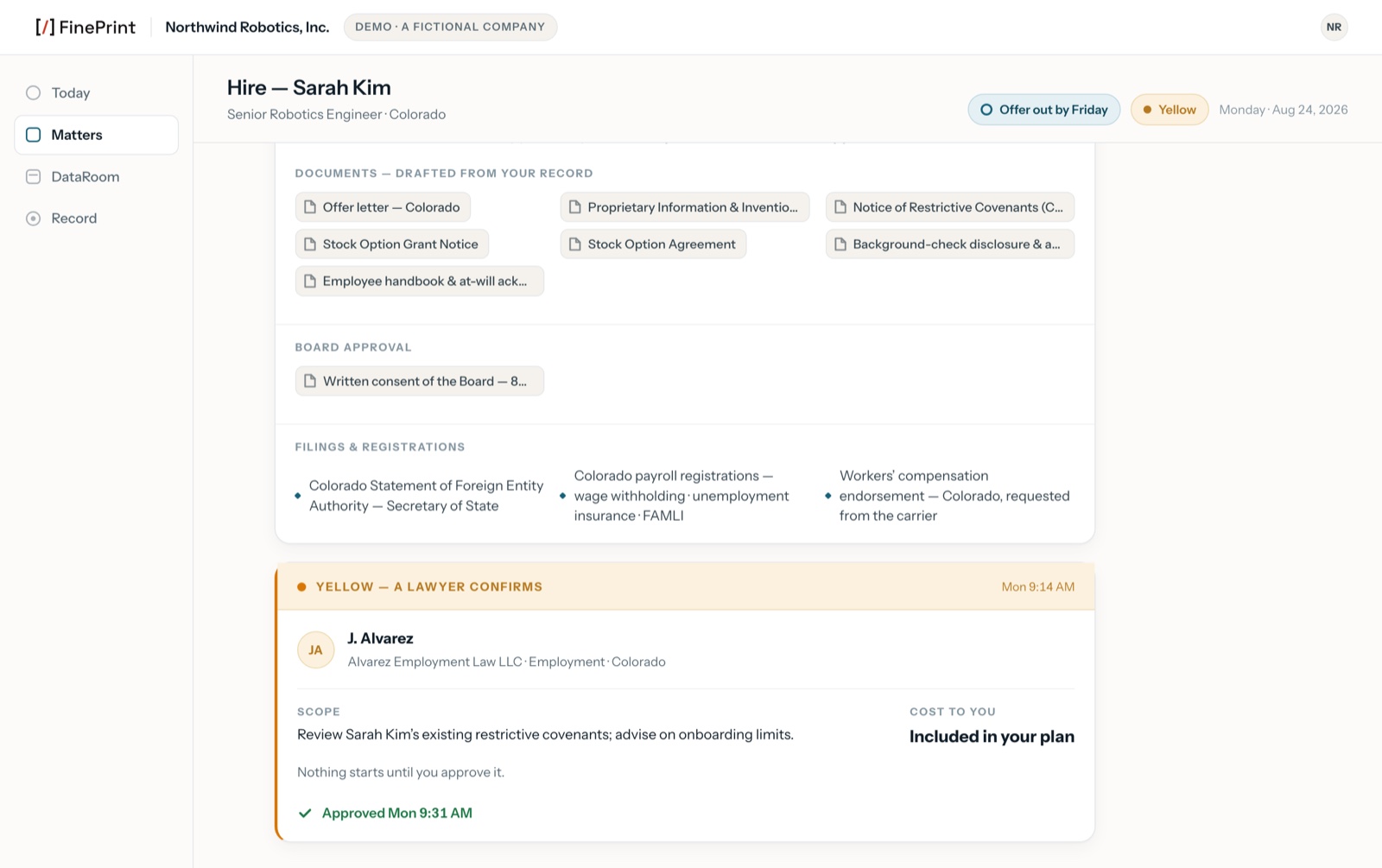
The outcome, for the record: a narrow customer non-solicit, twelve months, no bar to the hire, and one onboarding guardrail added to the invention-assignment agreement. The offer went out Thursday — a day early.
A review that only fixes one document is a service. A review that changes the endpoint is infrastructure. The network is built for the second thing.
FinePrint runs the work. The network reviews it. The reviews train OpenLegalLM. The work runs better.
A single correction never changes production behavior. Feedback is curated and quality-weighted before it becomes training signal — that is what RLLF is: reinforcement learning from legal feedback.
Regression, jurisdiction and escalation evals run before any release. Deterministic endpoint rules sit outside the model and the model does not get to override them.
The flag rate — how often reviewers correct the model’s work. A falling flag rate is quality you can watch. We publish it when the eval is published, not before.
For lawyers
Most legal AI treats attorneys as the thing being disrupted. We treat them as the thing being compounded. The judgment you apply to a review does not evaporate into a product someone else owns — it is measured, it is paid, and where it becomes knowledge the system reuses, you share in what it earns for as long as it keeps working.
You keep your practice. This is not a job and it is not a referral scheme. It is a queue you accept work from, on standards you can read before you accept anything.
01
A published rate per completed review, the same whether you accept, correct, reject or escalate. Reviews are timed and scoped so you know what you are taking before you take it.
02
Contribute a playbook, a position, a clause pattern. When endpoints use it, you share the revenue it generates — for as long as it keeps working, not as a one-time payment for a document.
03
Corrections, rankings, redlines and escalation calls are the RLLF signal behind OpenLegalLM. Attribution is kept, contribution is measured, and the standards you are marking to are published.
Tell us your jurisdictions and practice areas and we will send the review standards for the queues that fit.
Two different people, in two different situations. Green-lane output is reviewed by licensed attorneys who never learn whose work it is — the Clean Room strips your identity out before the sample reaches them. A Yellow or Red matter is reviewed by a named attorney you engage, whose name, jurisdiction and scope appear on screen before you approve anything.
Nobody who is not a licensed attorney reviews legal output for correctness. That is the whole point of the network.
No. FinePrint is a legal technology company. It does not practice law and does not provide legal advice. Where a matter requires legal judgment, a licensed attorney reviews it or takes it — engaged by you, with the scope shown first and the review included in your plan.
Privilege attaches to the relationship you form with the attorney you engage on a matter, which is why that engagement runs between you and them rather than through us. We keep it separable on purpose: the engagement is its own record, the attorney’s work product on your matter is held under that engagement, and the material a continuous reviewer sees is anonymized and is not your matter at all.
This is a place to be precise rather than reassuring: talk to your engaged attorney about how privilege applies to your specific facts and jurisdiction. How the engagement is kept separate
Continuous reviewers are paid by FinePrint, per completed review, at a rate that does not move with the outcome. There is no approval bonus and no penalty for flagging. Matter reviewers are paid by FinePrint for the engagement, on terms set before the matter is offered — never out of anything charged to you, because you are not charged for it. Revenue share is calculated on the usage of contributed knowledge, in a separate ledger from review pay, so no reviewer earns more by approving anything.
You approve one. Routing proposes the attorney — on jurisdiction, practice area, conflict status, load and measured quality — and you see who it is before anything begins. If you would rather have someone else, decline and the matter routes again. If you already have counsel you trust, they can take the matter with the same file built for them.
You can escalate it, and escalation goes to a second licensed attorney under the published escalation rule — not to us. What you cannot do is have the product overrule the lawyer, and neither can we. If the second attorney clears it, the endpoint proceeds; if not, the flag stands and you decide what to do with your own matter.
Only the attorney you engage on a matter, only for that matter, and only after you approve. Continuous review sees Clean-Room-anonymized artifacts on the learning side, which lives in a separate account from your record. OpenLegalLM learns from its contributors — never from your record.
The network is the reason the second half of that sentence is true.
See what the reviews are training — the model that does the reasoning inside every endpoint, and the release gates it has to pass.
Inside OpenLegalLMYou are a licensed attorney and this is the part you want to read properly. Tell us your jurisdictions and we will send the standards.
Talk to us