Nothing here is hard. There is just far too much of it.

At this stage the legal work stops being a series of events and becomes a rate. A DPA on every enterprise deal. A security review behind it. A new jurisdiction each time recruiting wins an argument. A second entity. A board that expects minutes rather than a shoebox. None of it is novel — and all of it arrives at once.

What breaks at growth.

The failure mode changes. Earlier it was a document that didn’t exist. Now it’s a hundred documents that exist, are all slightly different, and nobody can tell you which promise the company actually made.

01

Multi-state employment

Every state a person lives in brings its own registrations, its own notices at offer, its own leave rules and its own handbook addendum. Payroll runs fine whether or not any of it happened, which is precisely why it doesn’t happen. The bill arrives later as back penalties, or as a finding in the next round of diligence.

02

A DPA on every enterprise deal

Selling upmarket means every deal now carries a data processing agreement, a subprocessor list, breach-notification windows and a security review. Signed on the customer’s paper, these become operational commitments — and the team that has to meet them usually finds out about them after the ink is dry.

03

Contract volume

NDAs, order forms, MSAs, renewals, amendments. Each one is fifteen minutes of judgment and two hours of chasing. At this volume the real risk is not a bad clause; it’s drift — five account executives answering the same question five different ways because nobody wrote the position down.

04

Renewals and auto-renewals

Vendor agreements with notice windows measured in days, customer contracts that renew on terms you’d now negotiate differently, and a change-of-control clause in the one contract that matters most. Nobody is watching the calendar because the calendar is a hundred contracts long.

05

Subsidiaries

A second entity for a new market, an acquisition, or a structure someone recommended. Now there are two boards, two sets of filings, two registered agents, and intercompany agreements that need to exist for the IP to sit where the tax position assumes it sits.

06

A board that expects minutes

Institutional investors sit on the board now. Meetings need notice, agendas, minutes and consents, and committee approvals for things that used to be a Slack message. This is not difficult work. It is work that has to happen every quarter, on time, or it is a finding forever.

What FinePrint runs for you here.

At growth the weight shifts to Commercial and Compliance — the two categories that scale with revenue and headcount rather than with events. All six specialist agents are working the same record.

Commercial6

Paper in and paper out, drafted from your positions and tracked to renewal.

/create-nda /review-contract /create-msa /create-dpa /create-order-form /track-renewals
Compliance4

Every jurisdiction the company has walked into, registered and kept current.

/foreign-qualify /register-payroll-tax /annual-compliance /run-privacy-review
Hiring6

Offers that carry the right notices for the right state, and the exits that follow.

/hire-employee /engage-contractor /update-handbook /terminate-employment /onboard-intl-contractor
Governance6

The quarterly rhythm an institutional board expects, on time, every time.

/record-board-minutes /create-board-consent /hold-annual-meeting /adopt-policy

Two more matter once there’s a second entity: /incorporate stands the subsidiary up with its own board and filings, and /license-ip papers the intercompany terms so the IP sits where the structure assumes it sits. Both write into the same record, so the second entity’s calendar joins the first one’s rather than starting a new spreadsheet.

A worked example

An enterprise deal, on the customer’s paper.

A three-year subscription, redlined onto the buyer’s master agreement, with a data processing agreement, a subprocessor list and a security questionnaire attached. This is the transaction that eats a growth-stage company’s week, and it arrives several times a month.

The endpoint reads your positions — the ones you wrote down as policy, not the ones five people remember differently — and reads what you have already promised other customers. It returns a redline, a plain-English issue list, and one flagged question that a licensed attorney should answer rather than a model.

Matter M-2214 · enterprise subscription, buyer paper Running

RUN /review-contract

  counterparty paper · 3-year term · DPA and security review attached
  playbook: your positions · check: what we’ve already promised

read record — prior MFN terms, current subprocessors, live commitmentsTue 8:40 AM

14 deviations from playbook · 11 within your fallbacksTue 8:52 AM

uncapped liability, data incidents Yellow attorney & scope on screen · includedTue 9:15 AM

/create-dpa — subprocessor list generated from the recordTue 2:06 PM

/run-privacy-review — questionnaire answered from what is documentedTue 4:31 PM

redline and issue list returned to the account executiveWed 9:02 AM

/track-renewals — notice window on the calendarWed 9:04 AM

Back to the buyer inside a day. Executed agreement, DPA and questionnaire response filed in the Legal DataRoom. The renewal date and the notice window are on the calendar, and the commitments you just made are in the record — so the next deal’s answers know about them.

2

Credits for the contract review. The DPA and the privacy review draw their own, printed before each runs.

14

Deviations found against your written positions — eleven of which your own fallbacks already allow.

1

Question routed to a licensed attorney, with the scope on screen before it opened — and no charge on top of the plan.

0

Commitments made that the record doesn’t know about. That is the part that compounds.

Every new state is a small project.

One remote hire creates a set of obligations that begin the week they start and continue every year after. The specifics differ by state; the shape does not. FinePrint treats the state as part of the hire rather than as a task somebody files afterwards.

At offer

The notice that has to go out before they sign.

Several states require specific disclosures at or before the offer — pay ranges, restrictive-covenant notices, benefits summaries. Sent late, the requirement isn’t cured; in some states the covenant simply doesn’t bind. The hire endpoint knows which state it’s hiring into and produces the notice as part of the offer packet, not as a follow-up.

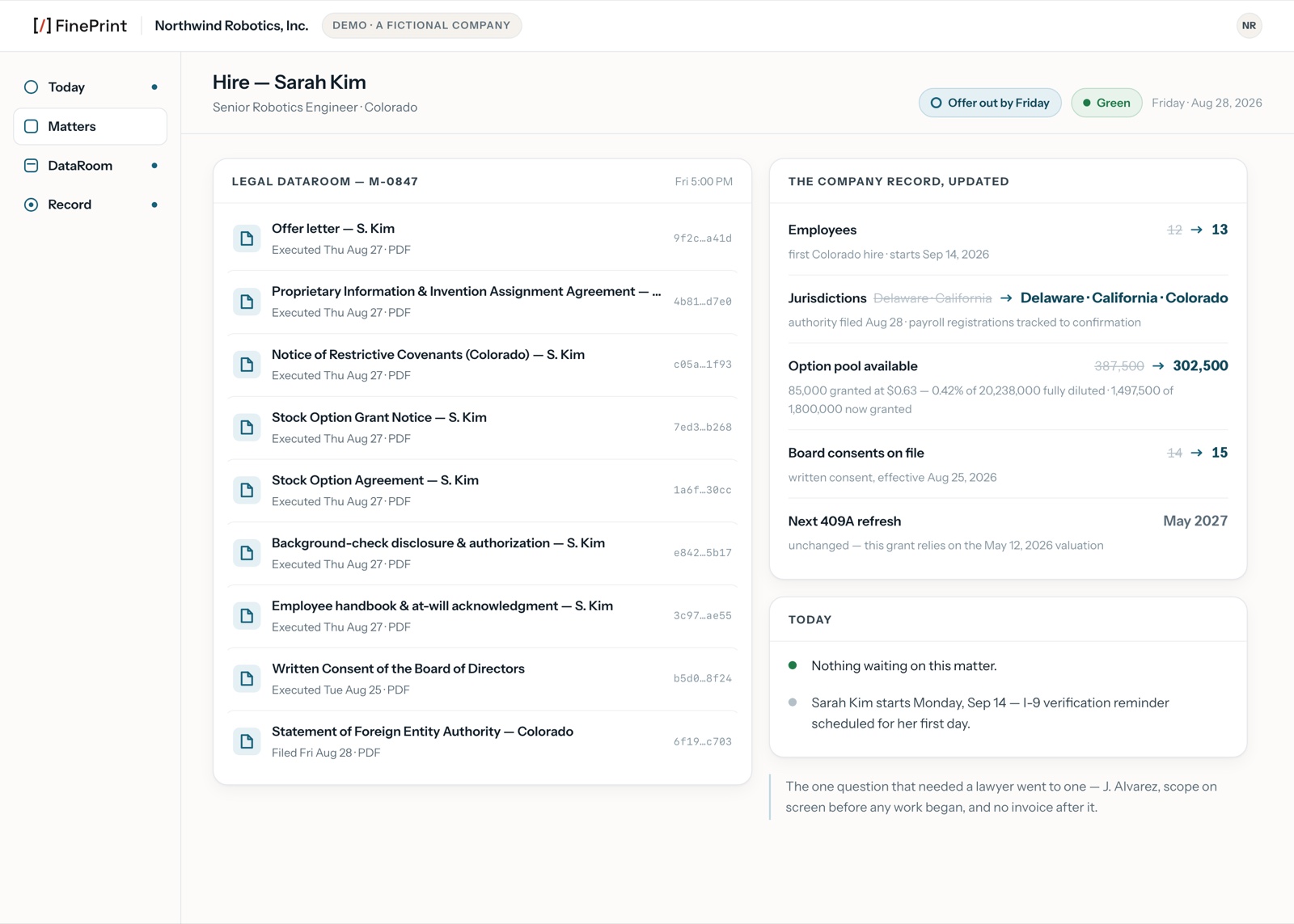
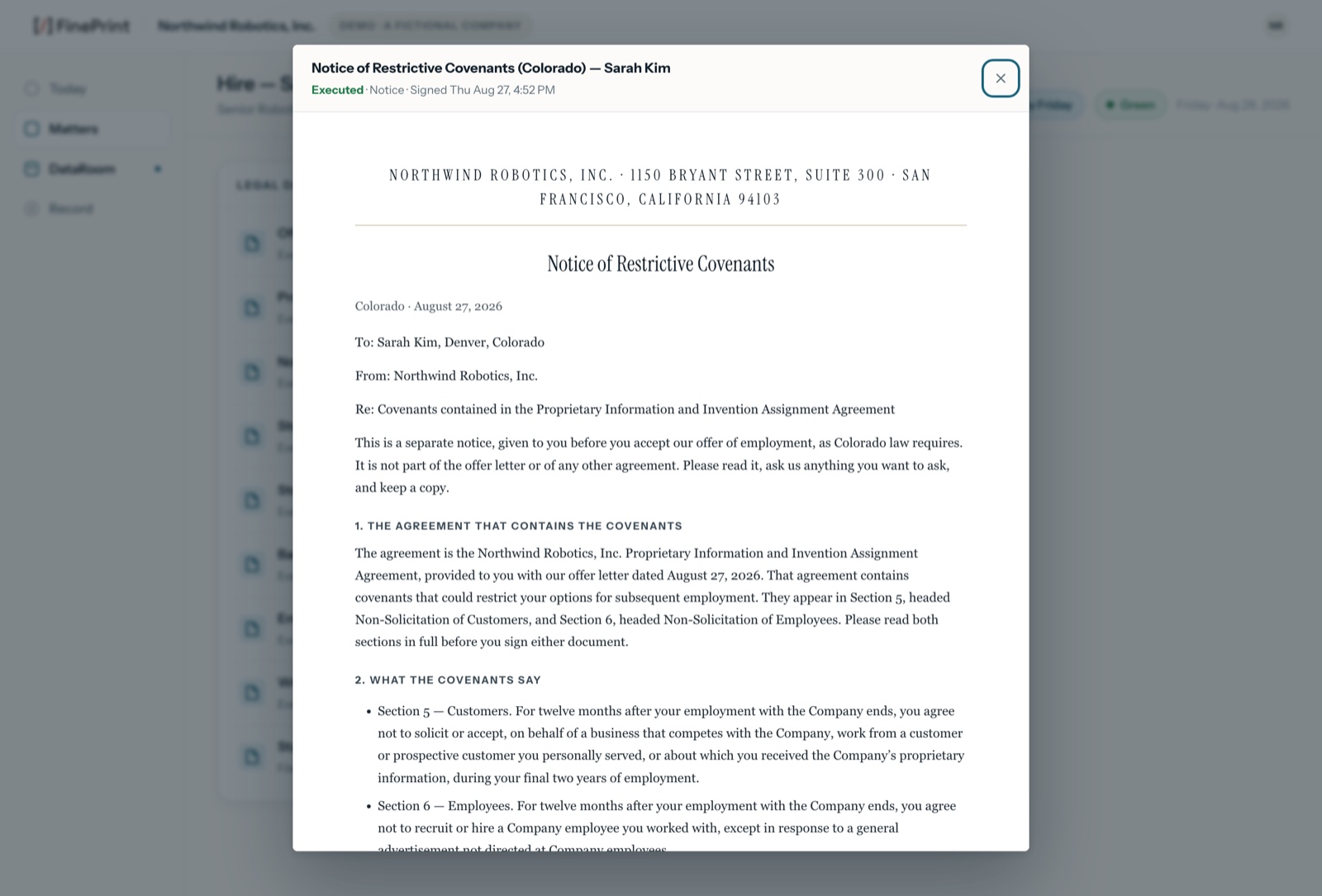
In the demonstration matter that’s Colorado’s restrictive-covenant notice, generated alongside the offer letter and the invention assignment agreement.

This is why the state is a field the endpoint reads, not a note in the recruiter’s head.

The Colorado restrictive-covenant notice, generated as part of the offer packet.
The Colorado restrictive-covenant notice — generated with the offer, not after it.

After the filings

The state joins the record, and then joins the calendar.

Once the registrations are through, the state isn’t a completed task — it’s a standing obligation. Annual reports, registered agent renewals, unemployment insurance filings, leave-program contributions, handbook addenda that change when the state’s rules change.

Because the state is in the record, the second hire there is a much smaller matter than the first, and the annual obligations arrive as items in Today rather than as letters.

The Legal DataRoom filling with executed documents while the company record updates itself.
The DataRoom fills and the company record updates itself — including the new state.

What each trigger creates

Trigger What it creates Endpoint
First employee in a new state Foreign qualification with the Secretary of State, a registered agent, payroll withholding registration, an unemployment insurance account, enrolment in any state paid-leave program, and workers’ comp coverage for that state. /foreign-qualify /register-payroll-tax
An offer into a state with notice rules State-specific disclosures produced with the offer packet — pay transparency, restrictive-covenant notices, required acknowledgments. /hire-employee
Headcount thresholds in a state Policies that switch on at a headcount: leave entitlements, training requirements, posting and reporting obligations, handbook addenda. /update-handbook /adopt-policy
An enterprise customer’s DPA Data processing terms, a maintained subprocessor list, breach-notification windows, and a security questionnaire answered from what’s actually documented. /create-dpa /run-privacy-review
A contract with an auto-renewal The renewal date and the notice window on the calendar, with the decision surfaced in Today before the window closes rather than after. /track-renewals
A second entity Its own charter, bylaws, board and officers, its own registrations and annual filings, and intercompany agreements so the IP sits where the structure assumes it does. /incorporate /license-ip
A quarterly board meeting Notice, agenda, minutes, and consents for anything approved between meetings — in date order, permanently. /record-board-minutes /create-board-consent
Any year rolling over Annual reports and franchise tax in every state you’re qualified in, registered agent renewals, and a 409A that has to stay current for grants to be issued at all. /annual-compliance /order-409a

Government fees on every row are passed through at cost — Secretary of State filings, registration fees, franchise tax. FinePrint doesn’t mark them up and doesn’t charge a credit for paying them.

The plan that fits.

Business — $2,499 a month. For a company that is raising and scaling. For the company, not per seat, which at this size is the point: the account executive who needs an order form and the recruiter who needs an offer both work in the same record.

  • Multiple entities — subsidiaries, their boards, their filings and the intercompany paper, held as one record rather than several.
  • Custom policies — your negotiating positions and fallbacks encoded, so the answer to a liability cap is the same on Friday as it was on Monday.
  • API access — endpoints called from the systems your team already lives in, so an order form is created where the deal is, not where the lawyer is.
  • All six specialist agents and priority matter review.
  • 900 credits a month — contract volume, multi-state hiring, quarterly governance and the filings underneath all of it.

Growth at $999 is still the right plan for a lot of companies at this stage. If you’re in one or two states, on one entity, and your contracts run on your own paper, you don’t need custom policies or an API — you need all six specialists and enough credits, and that’s what Growth is. Move up when a second entity appears, when the same clause is being negotiated inconsistently across a sales team, or when you want endpoints called from your own systems.

Enterprise is a different question, not a bigger one. It’s for companies bringing their own key management, their own governance, or their own paper for the engagement. If a security review has to be satisfied before anything can be signed, start there.

What still needs a lawyer at this stage.

At volume, the useful question isn’t which matters need an attorney. It’s which ones don’t — because that’s where the hours were going.

Green — agents execute.

NDAs, order forms and renewals. Contract review against your own written positions, where the deviations fall inside your own fallbacks. Standard DPAs and subprocessor lists. Hires and terminations on standard terms, with the right state notices. Foreign qualifications and payroll registrations. Board minutes, consents and the annual meeting. Subsidiary formation and its filings. All of it runs end to end with your approval, and the network’s reviewers score the output continuously.

Yellow — a lawyer confirms.

Uncapped liability for data incidents. A most-favored-nation clause that would reach back into contracts you’ve already signed. An indemnity that doesn’t match what your insurance actually covers. A classification question about a long-running contractor. A termination with a complaint behind it. An intercompany arrangement with a tax position resting on it. In each case the attorney and the scope are on screen before anything moves, nothing starts until you approve it, and the review is included in your plan.

Red — a specialist lawyer leads.

A regulatory inquiry. An acquisition, in either direction. Litigation, or the letter that precedes it. A cross-border structure. A data incident that has actually happened. The specialist takes the matter with the file already built — the record, every executed contract, the commitments you’ve made and to whom, and the issue list, assembled before the first call.

The most important thing the system knows is when it doesn’t know. At this volume that judgment is the product — a system that escalated nothing would be worse than no system at all.

FinePrint is a legal technology company, not a law firm, and does not provide legal advice. Where judgment is required a licensed attorney reviews the matter or takes it, engaged by you, with the scope shown first and the review included in your plan.

Growth-stage questions.

We already have a general counsel. What does FinePrint do for them?

Gives them back the two-thirds of the week that is production. The NDAs, order forms, DPAs, state registrations, board minutes, renewals and grant paperwork run as endpoints against the company’s own positions, and land in the record executed.

What’s left is the part a general counsel is actually for: the positions themselves, the deals that matter, the regulatory posture, and the judgment calls the system escalates rather than guesses at.

Can FinePrint work from our own playbook rather than a default one?

That’s what custom policies are, on the Business plan and up. Your positions and fallbacks — liability caps, indemnity language, data commitments, termination rights — are encoded, and the endpoints negotiate to them. The value isn’t that the position is better; it’s that it’s the same one every time, which is the thing that drifts fastest across a sales team.

How does this work alongside our CLM or contract-AI tool?

Those tools are good at the contracts they’ve ingested. FinePrint’s difference is that a contract is one object in a record that also holds the entity, the board, the cap table, the employees, the states and the filings — so a change-of-control clause can be read against who actually owns the company, and a data commitment can be read against what the company has already promised elsewhere.

With API access, endpoints can be called from systems your team already uses, so the record stays the record.

We’re about to stand up a subsidiary. Is that in scope?

Yes — the entity, its board and officers, its registrations and annual filings, and the intercompany agreements that put the IP where the structure assumes it is. Multiple entities is what the Business plan is for.

The structure decision itself — whether the subsidiary should exist, and where — usually carries a tax position, so it routes to a specialist rather than being answered by an endpoint.

Who answers the security questionnaires?

The endpoint drafts the response from what is actually documented about the system, and a person on your side approves it before it goes out. It won’t answer a question the record can’t support, which is the only useful behavior here — a questionnaire response is a commitment.

On FinePrint’s own posture: the record is encrypted and company-isolated with per-document keys, stored in Postgres with pgvector and S3 under per-tenant KMS keys, across two separated AWS accounts so customer data and learning data never share one. We state what’s true today and what’s in progress, and we don’t claim certifications we don’t hold.

What happens when a matter needs a lawyer in a state we’ve never dealt with?

Matter review is routed to a licensed attorney in the OpenLegal network admitted where the question lives, conflict-checked and properly engaged by you, with the scope on screen before anything begins. You aren’t finding local counsel; you’re approving a scope.

Can we call endpoints from our own systems?

Yes, on Business and Enterprise. The endpoint is the same either way — documents, approvals, signatures, filings, record updated after — so an order form created from the deal record behaves exactly like one created in FinePrint, including the approval step. Nothing runs without someone approving it.

More contracts, more states, more entities — the same headcount.

You stop buying legal work by the hour. You start having coverage that’s always on.

Run the free Legal Health Check. It reads what you already have and shows what’s missing, what doesn’t match, and what’s due soon — including the states you’re employing in without being registered in.

Find my legal gaps — free

Or talk to us. If you’re bringing your own policies, your own key management, or a security review that has to clear before anything is signed, that’s an Enterprise conversation and it should start with a person.

Talk to us