
Home Product Legal DataRoom

Every signed document, filed by the work that produced it.

A data room is usually something you build in a panic. This one is the by-product of the work: every endpoint files its own output, so the room is current by construction — and diligence-ready on a Tuesday for no particular reason.

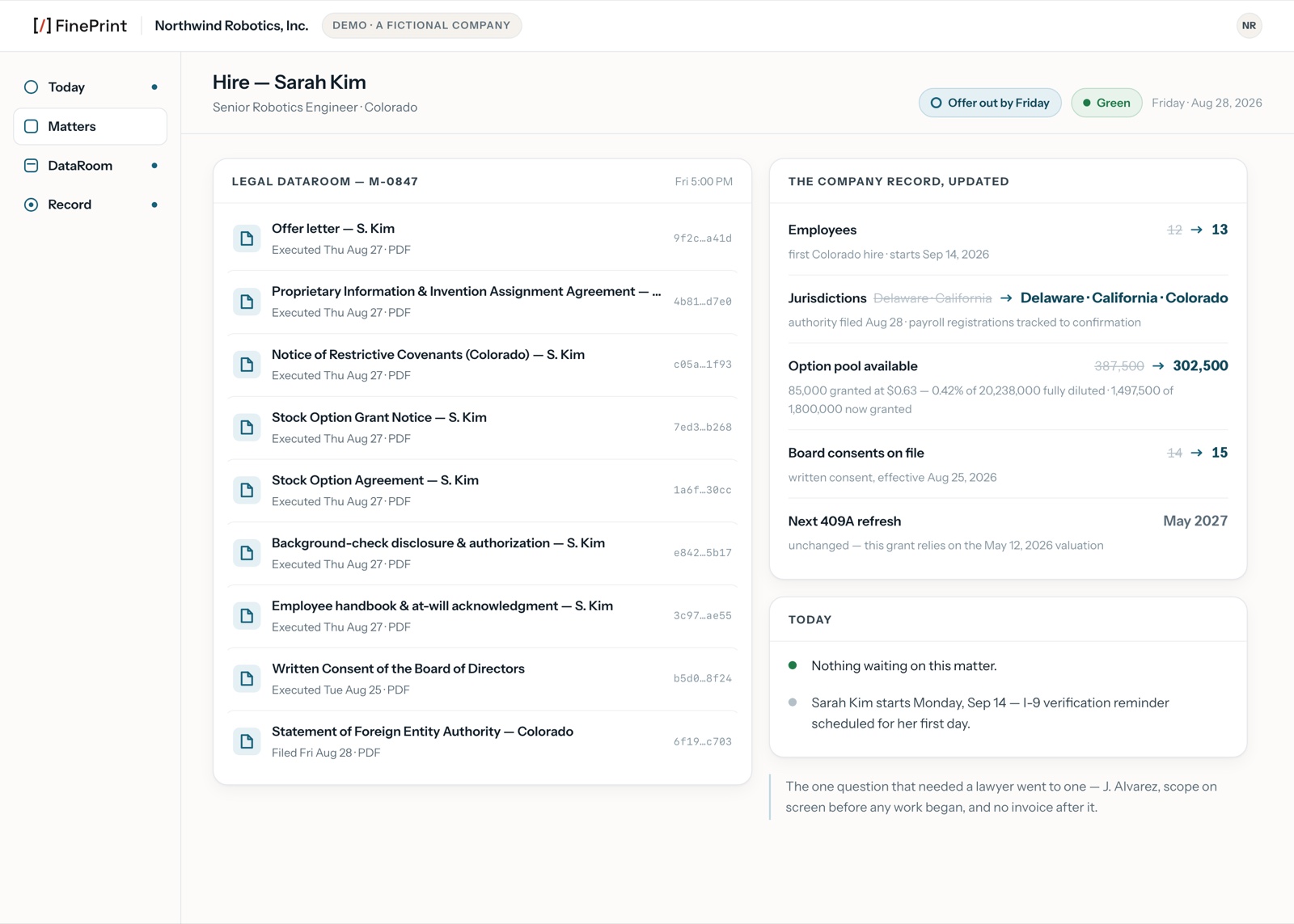
The FinePrint Legal DataRoom filling itself as a matter closes: executed documents landing on the left, the company record updating on the right — employees 12 to 13, option pool available 387,500 to 302,500.
The end of matter M-0847. Nobody filed anything: the executed documents land as the endpoint finishes with them, and the company record updates from the same event. Northwind Robotics is the fictional company in the product demo.

7

executed documents, filed by the endpoint that drafted them

1

board written consent, with all three signatures attached

1

filing receipt from the Colorado Secretary of State

0

documents anybody had to remember to upload

That is the whole idea. A folder you fill is only as current as the last person who thought about it. A room that is written by the work is current because the work happened.

Built for the work you do

Six times a year, somebody asks you for your paper.

Each of these is a week of somebody’s life at most companies. Here they are a room, scoped and shared, because the documents were already filed when they were signed.

01

Fundraising diligence

An investor sends the list. Charter and bylaws, every SAFE and the consent that authorized it, the option plan, the 409A, the 83(b) filings and their receipts, the IP assignments. All of it already sitting under the matters that created it — so the answer to “can you send us the data room” is a link, the same day.

02

An acquirer’s request list

Longer, and unforgiving about gaps. Every executed agreement with its signer list and execution date, every state you qualified into, every employment and contractor file with the assignment signed. What normally makes this brutal is reconstruction. There is nothing to reconstruct.

03

Board reporting

What the board approved since the last meeting, what was granted under those approvals, and what was filed. Consents, minutes, grants and receipts are already tied to the matters they came from, so the pack assembles from the record rather than from four people’s inboxes.

04

A customer security review

An enterprise buyer wants your paper before they sign: your NDA, your DPA, the commercial terms you actually agreed, your written policies. Share a scoped room instead of attaching six PDFs to a thread and hoping they were the current versions.

05

An audit or a state filing

Franchise tax, an annual report, a payroll registration, a foreign qualification. The receipts are filed next to the filings and the filings next to the matters that triggered them, with dates that a regulator can follow in one direction.

06

A new lawyer coming onto a matter

The expensive part of outside counsel is the first ten hours, spent learning your company. An engaged attorney arrives to a file that is already built: the record, the documents, the history and the issue list. You stop paying people to get up to speed on you.

The endpoint files it — you don’t. All forty-one endpoints write back when they finish: the executed documents into the DataRoom, the facts into the Company Legal Graph, the deadlines into Today. See the endpoints

What’s in a room — and who put it there.

Seven document classes, each written by the endpoints that produce them. The slug beside a row is not a label: it is the workflow that drafted the document, collected the signatures, made the filing, and then filed the result here.

Document classWhat it holdsFiled by
Charter & formation Certificate of incorporation and amendments, bylaws, founder stock purchase agreements, 83(b) elections with their mailing receipts. /incorporate /file-83b
Board consents & minutes Written consents with the full signer list, meeting minutes, director appointments and resignations, the resolutions each grant relies on. /create-board-consent /appoint-director
The cap table’s paper The equity plan, each option grant and its authorizing consent, exercises and their tax paperwork, SAFEs and notes with their side letters. /grant-options /exercise-options /issue-safe
Employment & contractor files Offer letters, invention-assignment and confidentiality agreements, state-required notices, contractor agreements and statements of work. /hire-employee /engage-contractor
Commercial agreements NDAs both directions, customer and vendor agreements, order forms, data processing terms — with the reviewed version and what was negotiated away. /create-nda /review-contract
IP assignments Assignments from founders, employees and contractors, trademark applications and their office correspondence, licenses in and out. /assign-ip /file-trademark
Filings & receipts Annual reports, franchise tax confirmations, foreign qualification certificates, payroll and unemployment registrations, workers’ comp endorsements. /annual-compliance /foreign-qualify

Company Legal Graph

What the company legally is — entity, ownership, board, contracts, IP, filings, obligations.

Legal DataRoom

The signed evidence behind every one of those facts, indexed by the matter that produced it.

Today

What needs a decision, and when. Fed by the dates the DataRoom already knows.

The credibility part

A PDF is not evidence. This is evidence.

Anyone can store a file. What makes a room survive diligence is that every document can answer six questions without a human vouching for it: which version, executed when, signed by whom, arising from what, unchanged since — and what it changed about the company.

  • Version — every draft and every executed version, in order, with the current one marked and the superseded ones kept.
  • Executed date — the moment the last signature landed, not the day somebody uploaded it.
  • Signer list — who signed, in what capacity, and when each one did.
  • The matter it came from — the endpoint that ran and the matter number it ran under.
  • A content fingerprint — a hash of the executed file, so “is this the document we signed” is a comparison rather than an argument.
  • The record fields it updated — the exact facts in the Company Legal Graph this document is the evidence for.
Legal DataRoom · entry

DOC offer-letter · S. Kim

  class: employment · status: executed Current

version 3 — v1, v2 retainedsuperseded

executed Sep 11 2026, 14:22 UTClast signature

signers — M. Okafor (CEO) · S. Kim2 of 2

matter M-0847 · /hire-employeesource

fingerprint 9f2c·a417sha-256

related — board consent · PIIA · CO covenant notice4 documents

Record fields updated by this document. Employees 12 → 13 · option pool available 387,500 → 302,500 · Colorado employee count 0 → 1 · first payroll date Sep 14 2026. Each of those facts links back here.

Why the fingerprint matters. Diligence questions are rarely “do you have it”. They are “is this the one that was signed”. A hash taken at execution turns that into a check anybody can run — you, your counsel, or the acquirer’s.

Share a room, not a folder.

Sending your legal paper to somebody should be a decision with edges: who, which documents, for how long, and what you can see about it afterwards.

Scoped rooms

Pick the matters or the document classes, and share the room that results. The investor gets the fundraising set; the acquirer gets everything; the customer gets the commercial terms and nothing about your cap table.

  • Built from the record, so it can’t go stale
  • Folder-level permissions per recipient
  • Links that expire on a date you set

Watermarking

Documents rendered for a shared room carry the recipient and the date, so a page that leaves the room still says where it came from. Downloads can be turned off entirely for a room where viewing is enough.

  • Recipient and date on every page
  • View-only rooms with downloads disabled
  • Revoke a recipient without rebuilding the room

A full access log

Who opened what, and when. Useful during a raise for the obvious reason, and useful afterwards for a less obvious one: it is the record of who you gave what to, kept for as long as you keep the room.

  • Per-document open events with timestamps
  • Per-recipient history across rooms
  • Exportable with the rest of your data
Read this as design, not as a certificate. The section above describes how sharing in FinePrint is built and what it is for. It is not a compliance claim and it is not an attestation — we do not claim any certification we have not earned. If you need to know exactly what is in your hands today versus what is on the way, ask us and we will tell you which is which, in writing. What we don’t claim yet

It’s yours. Including the leaving part.

A data room that holds your company hostage is not a data room, it’s a hostage situation. Everything FinePrint files for you is exportable in full, any day you choose — documents in their executed form, with the version history, the signer lists, the fingerprints and the matter each one came from, in an open structure rather than a proprietary bundle.

And when you want it gone, it goes. Deletion is permanent and applies to the copies as well as the original. There is no shadow corpus where your documents live on as training material, because there is nowhere for one to be: your record sits in a separate account from the learning side, and nothing crosses without anonymization and rights.

OpenLegalLM learns from its contributors — never from your record. That is the Two-Corpus Rule, and it is architecture before it is a promise.

What it costs. The Legal DataRoom is part of the subscription — in every plan, including Founder at $99 a month, alongside the company record and the free Health Check. It is not a per-seat add-on and it is not metered by storage. See the plans

Questions people actually ask.

How is this different from a folder in Drive or Box?

Storage is the part everybody has. The difference is where the contents come from. Nobody files anything into the DataRoom by hand — the endpoint that drafted the document, collected the signatures and made the filing writes the result here when it finishes, along with the version, the signers, the execution date, the fingerprint and the record fields the document proves.

A folder tells you a file exists. The DataRoom tells you what the file is evidence of, which is the question diligence actually asks.

What about documents we signed before FinePrint, or signed somewhere else?

Bring them. The free Legal Health Check exists partly for this: connect the documents you already have and FinePrint reads them, builds the first version of your company record, and files what it finds. Documents that arrive from outside are marked as such — they carry what we can verify about them rather than what an endpoint observed, and the difference is visible in the entry.

Who can see a room I share?

The recipients you named, for the documents you scoped, until the link expires or you revoke it — and you can see who opened what. Sharing is an explicit act each time; there is no default-public room and no link that outlives the decision to create it.

Do my documents train your model?

No. OpenLegalLM learns from knowledge that licensed attorneys contributed on purpose, with rights and provenance. Your record is retrieved for your matters and is never training material for a shared model. Customer data and learning data sit in separate AWS accounts that never share one, with per-tenant keys on your side.

Can I get everything out?

Yes, any day, in full, without asking anybody’s permission or opening a support ticket — the executed files with their version history, signer lists, fingerprints and matter references. Export is a product feature, not a retention negotiation.

Does this replace my cap table software?

No, and it is not trying to. Cap table software models the ownership; the DataRoom holds the paper that ownership rests on — the plan, the authorizing consent, the grant, the exercise, the 83(b) and its receipt. The two agree more often when one of them is generated by the workflow that created the paper.

Is a document in here legally sufficient on its own?

A document is sufficient or not on its own terms, and that is a legal judgment. FinePrint is a legal technology company, not a law firm, and does not provide legal advice. Where a matter requires judgment, a licensed attorney reviews it or takes it — engaged by you, with the scope shown before any work begins and the review included in your plan.

Diligence-ready on a Tuesday.

Not because somebody spent the weekend on it. Because the work filed itself.

Connect the documents you already have. In about four minutes: one score, the exact list behind it, and the first version of your company record.

Find my legal gaps — free

Raising soon? See what the room looks like from the other side of the table, and what an investor’s request list actually costs you.

Series A diligence