Diligence tests your record, not your lawyers.

A request list arrives with about ninety items on it. Your counsel can answer every one of them — but only from documents that exist, agree with each other, and can be found. That is not a legal problem. It’s a bookkeeping problem that has been accumulating quietly for eighteen months, and it surfaces in the four weeks you least want it to.

What breaks at Series A.

Nothing on this list is exotic. Every one of them is a thing that was true and correct on the day it happened, and then quietly stopped being reconciled to everything else.

  • The request list itself

    Ninety-odd items across corporate, equity, employment, IP, commercial and compliance, delivered with a two-week expectation. Most of it is “send us the document.” The pain is never the drafting — it’s discovering, item by item, which documents were never created, and doing it in front of the people wiring the money.

  • A cap table and consents that disagree

    The cap table says 85,000 options were granted in March. The board minutes have no March approval, or approve a different number, or approve it at a strike price the 409A doesn’t support. Each grant has to be traced back to the authorization behind it, and the ones that can’t be traced have to be ratified — which is a board action taken under time pressure with investors watching.

  • A 409A that expired

    A valuation is good for twelve months, or until a material event — and a term sheet is a material event. Options granted on a stale valuation carry a tax problem for the employees who received them, which makes it their problem as well as yours. Grants issued in the gap are the ones that get re-papered.

  • Option grants that were never board-approved

    An offer letter promises 85,000 options. HR enters it in the equity system. Nobody drafts the written consent, so the grant exists in three places and was authorized in none of them. This is the single most common finding, and it compounds: every unratified grant is also a wrong number in the fully-diluted table the round is priced off.

  • Employees in states the company never registered in

    Remote hiring means the first person in a new state creates obligations the same week they start: foreign qualification, payroll withholding, unemployment insurance, any state paid-leave program, workers’ comp. Nobody notices because payroll runs anyway. Diligence notices, and so does the state, eventually, with back penalties attached.

  • Contracts nobody can produce

    The material customer agreements are asked for by name. The signed versions are in an inbox, a Dropbox, a CRM and a former employee’s Google Drive. Assignment and change-of-control clauses in those contracts are read closely by investors’ counsel, and the company frequently learns what they say at the same time the investors do.

The diligence checklist, answered before the request list arrives.

This is what the corporate half of a Series A request list is actually asking for, what investors’ counsel look at when they read it, and where it lives if FinePrint has been running the company’s legal work all along.

What’s asked for What counsel are checking Where it lives What usually goes wrong
Charter and all amendments, as filed Authorized shares, par value, and that every amendment was properly approved by the board and the stockholders. Legal DataRoom · Corporate An amendment was filed but the stockholder consent behind it was never collected.
Bylaws, current version Quorum, consent mechanics, indemnification — every board action is measured against this. Legal DataRoom · Corporate Two versions in circulation and no record of which was adopted.
All board consents and minutes since formation That every issuance, grant, plan adoption, officer appointment and bank authorization has an approval behind it, in date order. Legal DataRoom · Governance Gaps. The company acted; the board never formally did.
Capitalization table, fully diluted That it reconciles line by line to the stock ledger, the option plan, and the consents that authorized each grant. Company Legal Graph Three versions — the spreadsheet, the equity system, and the consents — none of which agree.
Stock purchase agreements and 83(b) elections That founder stock was actually issued, and that each election was filed inside its thirty-day window with proof of mailing. Legal DataRoom · Formation The election was filed. Nobody kept the proof.
Option plan, every grant, and the 409A behind it That each grant was board-approved, priced at or above fair market value, and issued while the valuation was still current. Company Legal Graph · Equity Grants made in the gap after a valuation went stale, or after a material event reset it.
Every SAFE, note and side letter Conversion mechanics, discounts and caps — and whether any investor was promised something the others weren’t. Legal DataRoom · Fundraising A side letter with a most-favored-nation clause that quietly upgrades everyone else.
IP assignments from everyone who built anything Founders, employees and contractors — with no gap between when a person started and when they signed. Legal DataRoom · IP A contractor from year one who never signed, and no longer answers email.
Offer letters, PIIAs and the employee list That every current and former employee signed a confidentiality and invention assignment agreement, and that contractors are properly classified. Company Legal Graph · Employment Contractors doing full-time work on the company’s tools and schedule.
State registrations for every state you employ in Foreign qualification, payroll withholding, unemployment insurance, state leave programs, workers’ comp. Company Legal Graph · Compliance Three remote hires, three states, zero registrations — and payroll running fine the whole time.
Material customer and vendor contracts Assignment and change-of-control clauses, exclusivity, most-favored-nation terms, uncapped liability, auto-renewals. Legal DataRoom · Commercial A change-of-control consent requirement in your largest contract, found in week three.
Data processing agreements and privacy commitments What you promised customers about their data, and whether the product matches the promise. Legal DataRoom · Commercial A DPA signed on the customer’s paper committing to controls nobody told engineering about.
Good standing and franchise tax Certificates of good standing in Delaware and every state you’re qualified in, and franchise tax paid. Company Legal Graph · Compliance Good standing lapsed over an unpaid annual report, discovered at signing.

The point of the middle column. If FinePrint has been running the work, none of this is a retrieval exercise — the executed documents landed in the Legal DataRoom as each endpoint finished, and the graph was updated after. Sharing a diligence room is a click. If FinePrint is arriving in the middle of a round, the free Legal Health Check reads what you already have and produces exactly this list, sorted into missing, doesn’t match, and due soon.

What FinePrint runs for you here.

Series A work concentrates in four categories. These are the endpoints that keep the cap table, the board and the payroll map telling the same story — which is the whole game at this stage.

Twenty-one of the forty-one endpoints carry almost all of a Series A company’s routine work.

Governance6

The approvals investors will read in date order. Consents drafted from the record, routed, countersigned, filed.

/create-board-consent /record-board-minutes /appoint-director /hold-annual-meeting /amend-charter
Equity6

Every grant traced to the plan, the pool, a current 409A and the consent that authorized it.

/grant-options /exercise-options /adopt-option-plan /increase-option-pool /order-409a
Fundraising5

The instruments before the round and the room the round is run out of.

/issue-safe /issue-convertible-note /prepare-data-room /prepare-priced-round
Compliance4

Every state a person actually lives in, registered before diligence asks.

/foreign-qualify /register-payroll-tax /annual-compliance

Hiring endpoints sit alongside these and are where most of the volume actually is — /hire-employee and /engage-contractor both write into the same record the equity and compliance endpoints read from. That’s why an offer letter can’t promise a grant the pool can’t support: the endpoint checks the record before it drafts.

One hire, start to finish.

Northwind Robotics — a fictional Delaware C-corp, twelve employees, $4.2M seed — hires Sarah Kim, a senior robotics engineer, remote from Denver. She is the company’s first Colorado employee. That single fact turns an offer letter into a matter with seven documents, a board approval, and a set of state filings behind it.

Step 01 · Read the record

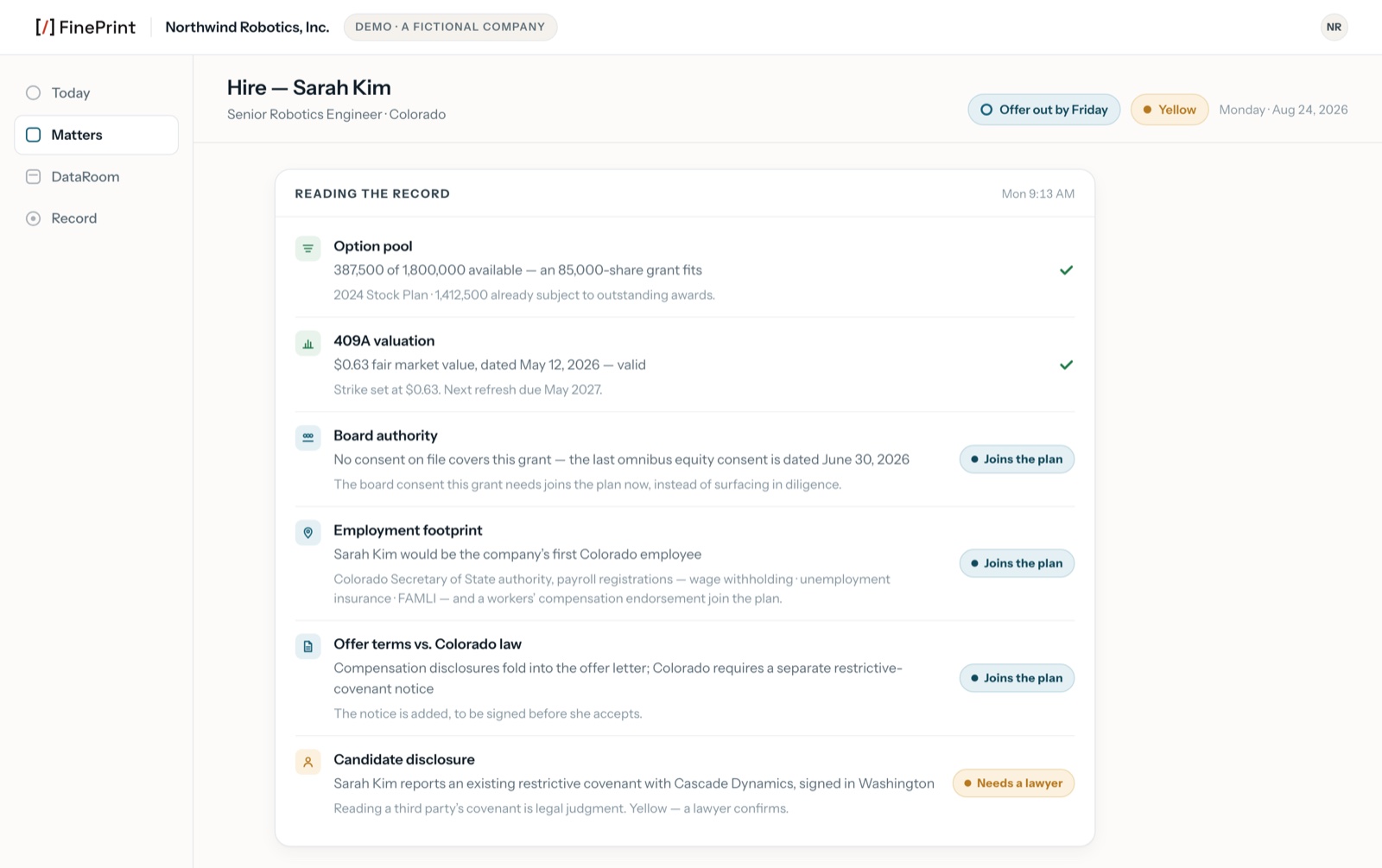
Before it drafts a word, it checks what’s actually true.

Option pool: 387,500 available of 1,800,000. A 409A dated May 12 2026, still current, supporting a $0.63 strike. Board authority to grant under the existing plan. The grant is 85,000 options — 0.42% fully diluted — which the pool supports, leaving 302,500 after.

Had the valuation been stale or the pool short, the endpoint would have stopped here rather than drafting an offer the company couldn’t honour.

This is the step that makes the difference at diligence. Every number in the seven documents came from the record, not from a person retyping it.

FinePrint reading the company record: option pool, 409A valuation and board authority resolving before any document is drafted.
Reading the record — pool, 409A and board authority, resolved before drafting.

Step 02 · The plan, on screen

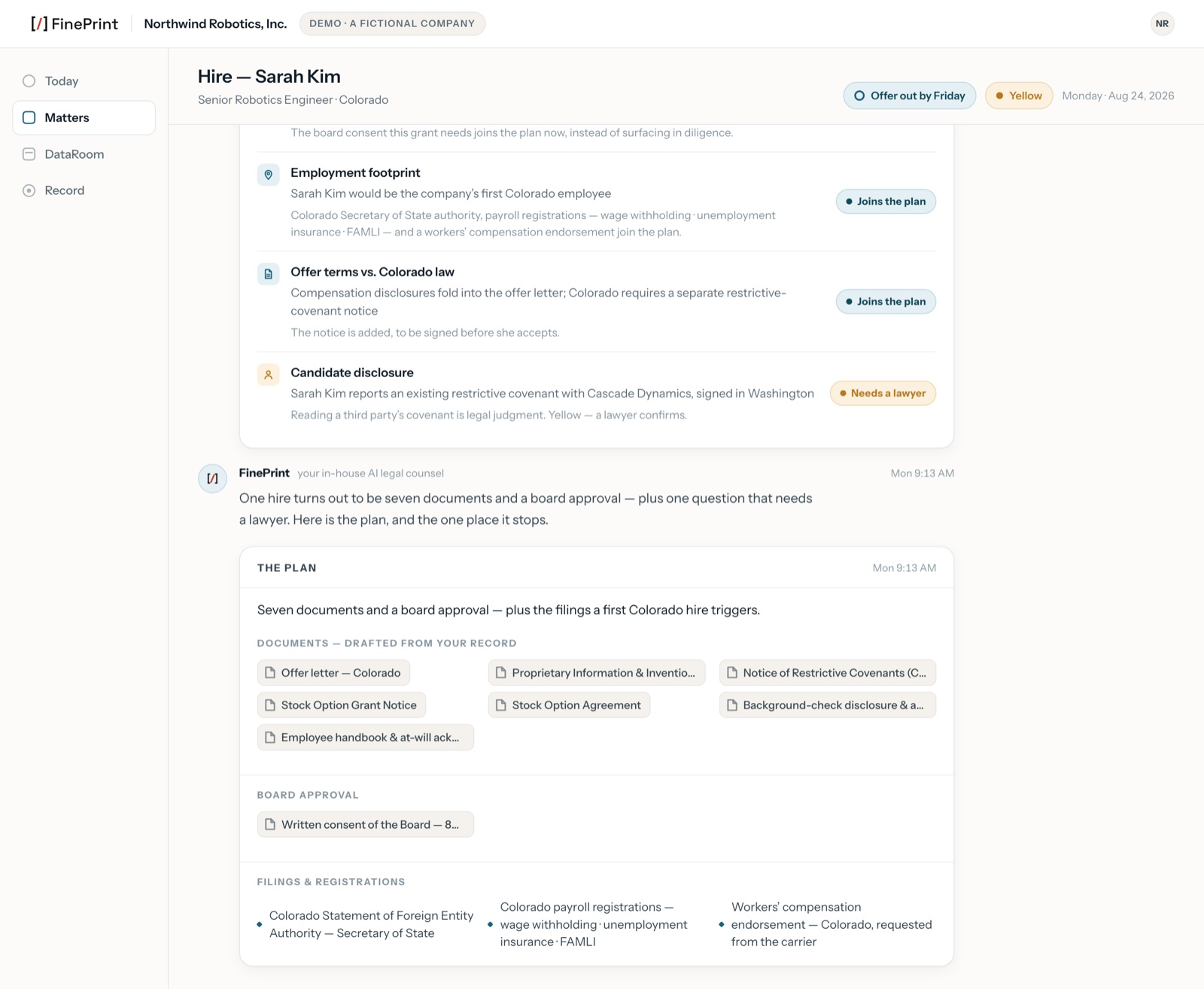
Seven documents, one board approval, and the filings Colorado will want.

The offer letter. The confidential information and invention assignment agreement. The option grant notice and agreement. The at-will acknowledgment. The Colorado restrictive-covenant notice. The board written consent authorizing the grant. And the state work: a Statement of Foreign Entity Authority, payroll registrations for wage withholding, unemployment insurance and FAMLI, and a workers’ comp endorsement.

Nothing has run yet. The whole plan — every document, every approval, every filing and what each one draws — is on the screen first. Nothing starts until you approve it.

The plan for the hire: seven documents, a board approval, and Colorado filings and registrations, listed before anything runs.
The plan: 7 documents, a board approval, filings and registrations — before anything runs.

Step 03 · The one Yellow

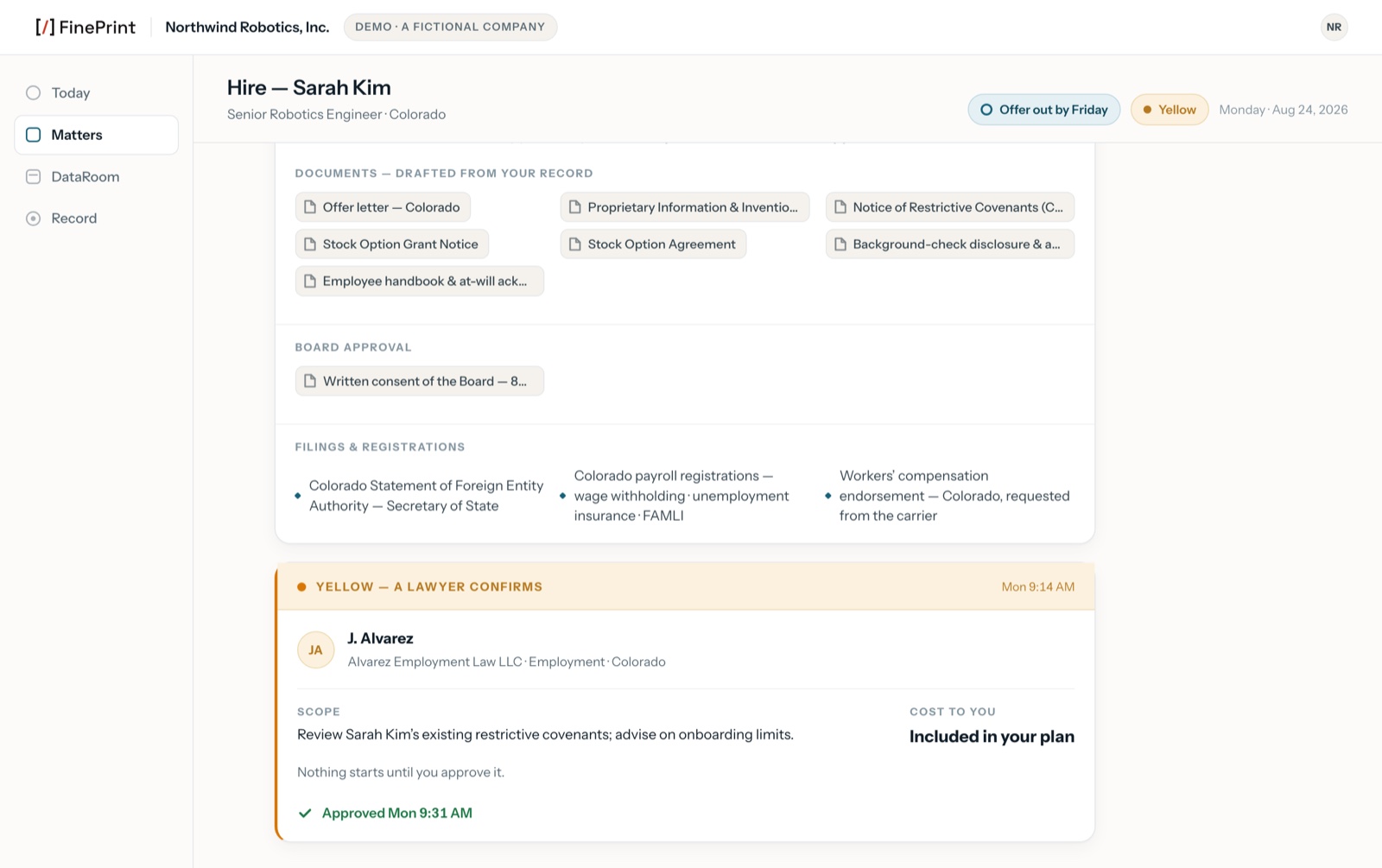
One question in the matter needed a licensed attorney.

Sarah has an existing restrictive covenant with a former employer, Cascade Dynamics. That is a judgment call about enforceability in Colorado against a specific set of facts, and no model should make it. FinePrint stops, names the attorney and states the scope: J. Alvarez, employment, Colorado. There is no fee to approve — attorney review is part of the subscription. What you approve is the scope.

Approved Monday 9:31 AM. Cleared Wednesday 11:40 AM: a narrow customer non-solicit, twelve months, no bar to the hire, with one onboarding guardrail added to the PIIA. The other twelve steps in the matter stayed Green and kept running.

The attorney and the scope are on screen before anything moves — and the engagement is between you and the attorney, conflict-checked first.

The Yellow card: J. Alvarez, employment, Colorado, the scope of the question, and the cost to you shown as included in your plan, before any work starts.
The Yellow card — the attorney and the scope, before any work starts. No fee: the review is in the plan.

Step 04 · The board consent

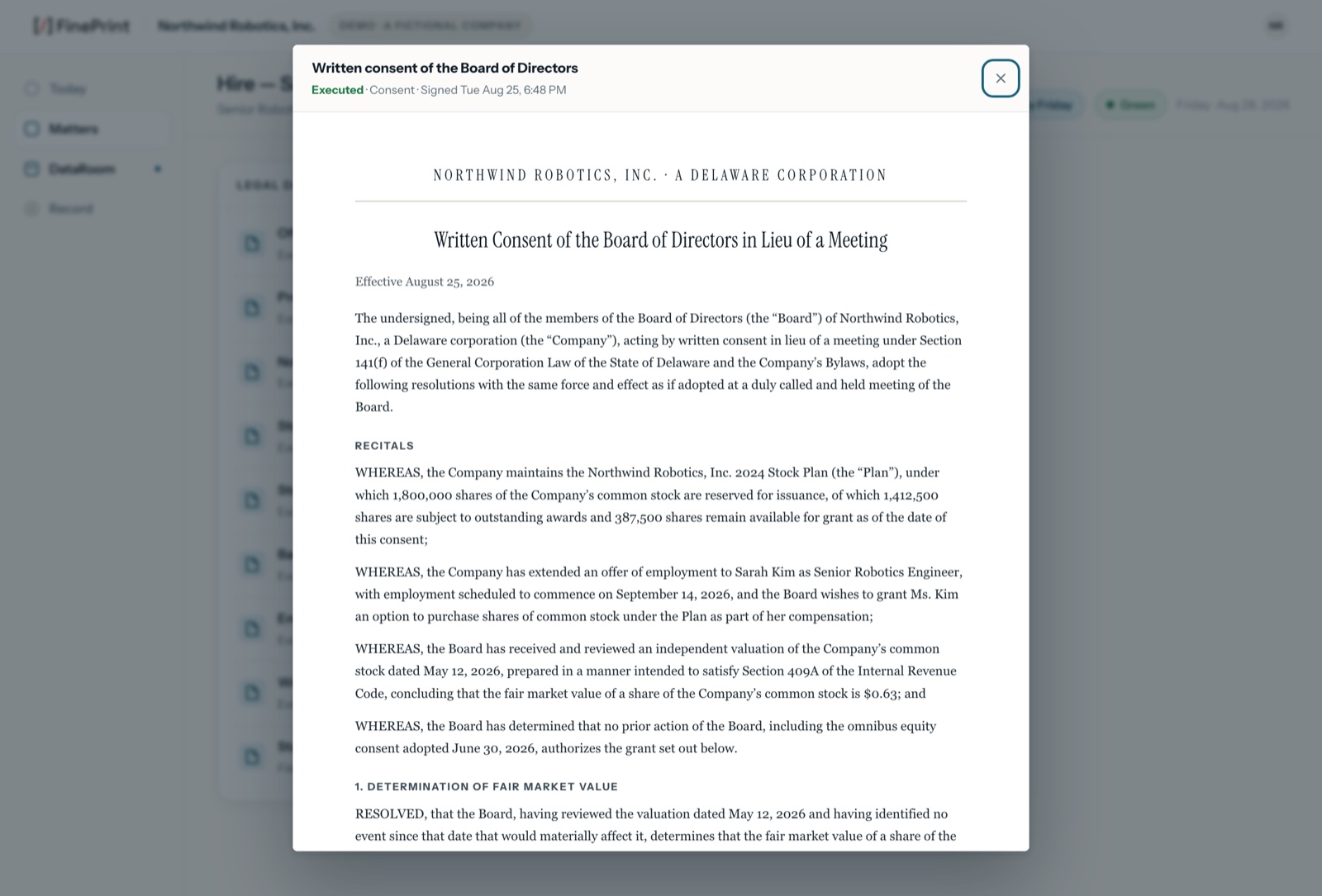
The document that makes the grant real.

A written consent with the grant table in it: grantee, 85,000 shares, $0.63 exercise price, four-year vest with a one-year cliff, and the plan it’s issued under. Drafted from the record, routed to the directors, countersigned, and filed in the Legal DataRoom next to the grant it authorizes.

This is the row that goes missing at almost every company, and the reason a cap table stops reconciling. Here it isn’t a separate task somebody has to remember — it’s part of the endpoint.

The board written consent with the option grant table: grantee, share count, exercise price and vesting schedule.
The board written consent, with the grant table — filed next to the grant it authorizes.

Step 05 · Filed, and written back

Offer out Thursday — a day early.

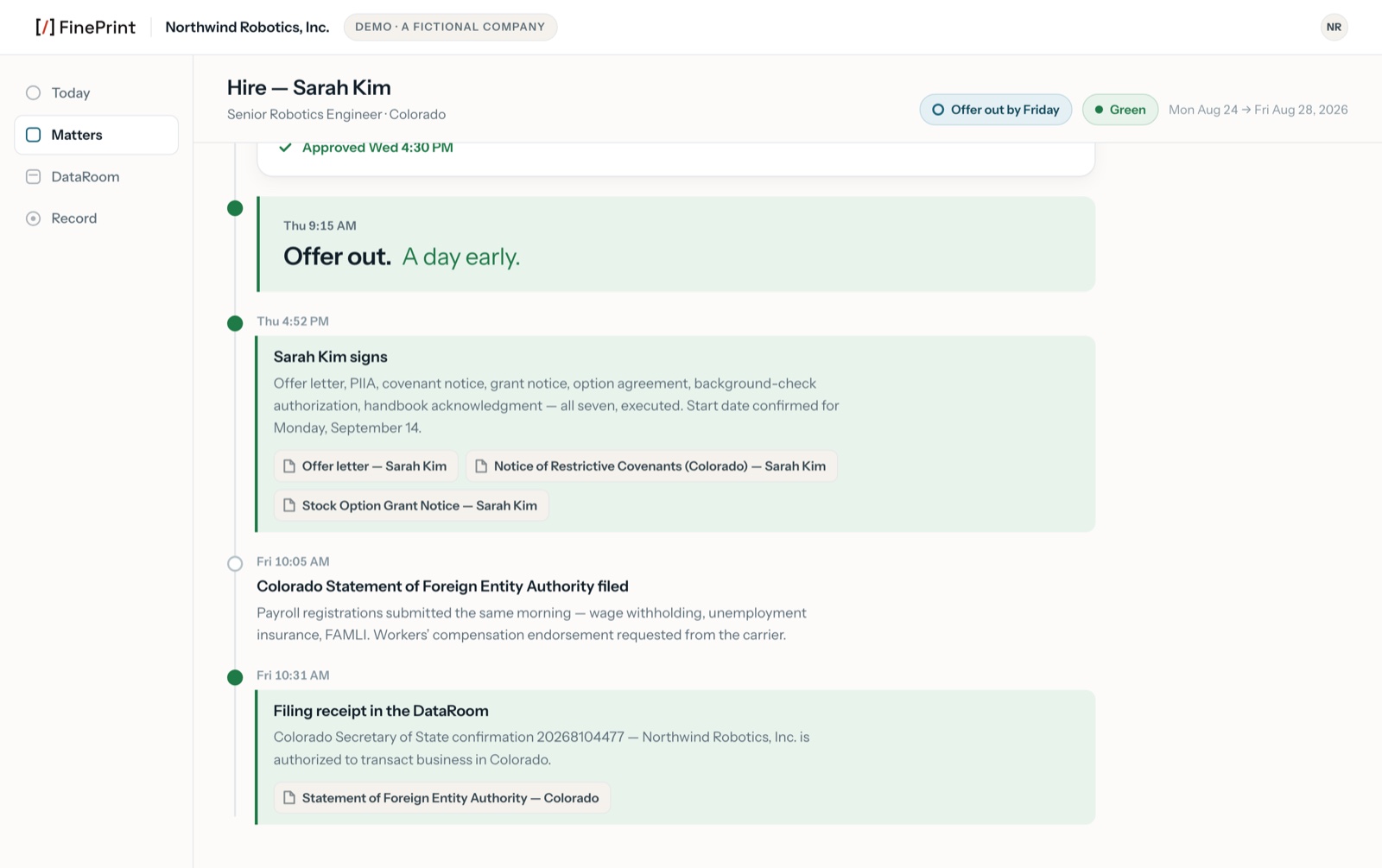
The Colorado Secretary of State filing goes in, the payroll registrations are submitted, the receipts land in the Legal DataRoom, and the record updates itself: employees 12 → 13, pool available 387,500 → 302,500, Colorado added to the states the company employs in — which means Colorado’s ongoing obligations are now on the calendar too.

Matter M-0847, closed. Nine credits and the Colorado filing fees at cost. The attorney review added nothing. The next endpoint that reads the record reads the new one.

The Colorado Secretary of State filing, payroll registrations and the filing receipt landing in the Legal DataRoom.
Colorado SOS filing, payroll registrations, receipts landing in the DataRoom.

Northwind Robotics, Sarah Kim, Cascade Dynamics and J. Alvarez are fictional, and the matter is a demonstration. The mechanism — read the record, show the plan, bring in the lawyer where the model stops, run it, write back — is the product.

The plan that fits.

Growth — $999 a month. For a company with a real team and a board. For the company, not per seat — the founder, the recruiter and the finance lead all use it.

  • All six specialist agents — Commercial, Employment & HR, Corporate, Privacy, data & AI, IP & brand, Compliance & risk. At this stage you need all of them, because diligence asks all of them.
  • Priority matter review — when a matter goes Yellow or Red mid-round, it doesn’t queue.
  • 300 credits a month — roughly thirty hires’ worth of endpoint work, or a quarter of contracts, consents and grants at Series A volume.
  • The full Legal DataRoom, which is also the diligence room you share in a click.
  • Government fees at cost — state filings, franchise tax, registrations. No markup.

Startup at $299 is not enough here, and it’s worth being blunt about why. It gives you two specialists. A Series A company that has employment questions but no corporate coverage has the wrong half — and every option grant needs both at once.

Move up to Business — $2,499 — when a second entity appears, when you want your own negotiating positions encoded as policy rather than decided case by case, or when the volume of contracts justifies calling endpoints from your own systems through the API. Multiple entities is usually the trigger, and it usually arrives with international expansion.

What still needs a lawyer at this stage.

The round itself is Red. Almost everything around it isn’t — and that split is where the money goes.

Green — agents execute.

Option grants against a current 409A and an approved plan. Board consents and minutes. Hires on standard terms. NDAs, order forms and standard commercial paper. State registrations and foreign qualifications. Assembling the diligence room and reconciling the cap table to the consents behind it. All of it runs end to end with your approval, and the network’s reviewers score the output continuously.

Yellow — a lawyer confirms.

A restrictive covenant from a candidate’s previous employer. Ratifying grants that were never properly authorized. A contractor whose classification is genuinely arguable. A material contract with a change-of-control consent requirement. A customer’s own DPA committing you to controls you need to check you actually meet. Each one gets an attorney and a scope on screen before anything moves, with nothing billed on top of the plan.

Red — a specialist lawyer leads.

The priced round. Negotiating the term sheet, the stock purchase agreement, the investors’ rights agreement, protective provisions and board composition — that is a specialist’s work and it should stay that way. What changes is what the specialist starts with: the record, the documents, the history and the issue list, assembled before the first call, rather than four weeks of reconstruction billed by the hour.

You never pay extra for any of it. OpenLegalLM carries what the network has already taught it, so most matters run on knowledge licensed attorneys contributed. When a matter falls outside that knowledge, it goes to the network — and what comes back becomes part of what the model knows. The next company to ask that question doesn’t need the lawyer.

FinePrint is a legal technology company, not a law firm, and does not provide legal advice. Where judgment is required a licensed attorney reviews the matter or takes it, engaged by you, with the scope shown first and the review included in your plan.

Series A questions.

We already have a firm running the round. What does FinePrint do?

Everything the firm shouldn’t be billing you for. Assembling and maintaining the diligence room, reconciling the cap table to the consents behind it, chasing missing signatures, papering grants, registering the states you hire in, and answering the two-thirds of the request list that is “send us the document.”

The firm keeps the round — the term sheet, the definitive documents, the negotiation. It just starts from a file that’s already built.

Can you fix option grants that were never board-approved?

The mechanics, yes: the record shows which grants have no authorization behind them, and /create-board-consent drafts the ratifying consent and routes it. Whether ratification is the right remedy for a particular grant — and what it means for the strike price and the employee’s tax position — is a judgment call, so it routes Yellow, with the attorney and the scope on screen first, included in the plan.

How long does it take to get a diligence room ready if we start from nothing?

We’re not going to give you a number we haven’t measured. What we will say is what determines it: how much of the record already exists as signed documents, and how many gaps need a new board action rather than a retrieval. The free Legal Health Check reads what you have in about four minutes and produces the actual gap list, which is the only honest way to answer this for your company.

What happens when we hire into a state we’ve never employed in?

The hire endpoint reads the record, sees there’s no registration in that state, and adds the state work to the plan before the offer goes out: foreign qualification, payroll withholding, unemployment insurance, any state leave program, workers’ comp. The Sarah Kim matter above is exactly that case, in Colorado.

The ongoing obligations for that state then join the calendar, so the second hire there is a smaller matter than the first.

Will investors’ counsel accept documents generated this way?

They accept executed documents with proper authorization behind them, which is what these are — and the authorization trail is usually cleaner than what they’re used to receiving, because the consent is part of the endpoint rather than a separate task someone had to remember.

Where a matter carried real judgment, there is also a licensed attorney’s review attached to it, with the scope on the record.

Is our data used to train the model?

No. That’s the Two-Corpus Rule: OpenLegalLM learns from its contributors — the playbooks, positions, clause patterns and corrections that licensed attorneys contribute on purpose — and never from your record. Your documents are retrieved for your matters and are never training material for a shared model.

The record is encrypted and company-isolated, with per-document keys, and customer data and learning data are held in separate AWS accounts that never share one.

What does a reviewing attorney actually see?

A reviewer sees your live matter only when you’ve engaged them on it. Everything the network reviews continuously has been anonymized through the Clean Room pipeline first.

The independence is structural: published standards, an application side that cannot override a reviewer’s flag, and reviewer pay that is never contingent on approving anything.

Be the company whose diligence room was already there.

The request list is not a surprise. It’s the same list every time.

Run the free Legal Health Check. It reads the documents you already have and produces the gap list above — missing, doesn’t match, due soon — in about four minutes, and builds the first version of your company record while it runs.

Find my legal gaps — free

Or look at where the room lives. The Legal DataRoom is the diligence file, filling itself as each endpoint finishes — and it’s the same object you share with investors’ counsel in a click.

Inside the Legal DataRoom