
One legal workflow, start to finish.
One matter, frame by frame. Northwind Robotics is hiring Sarah Kim — a senior robotics engineer, remote from Denver, the company’s first employee in Colorado. The CEO wants the offer out by Friday. Every screen below is the running product.
Northwind Robotics, Inc. and everyone in it are fictional. Nothing here is a real transaction, and nothing here is legal advice.
Watch it
The whole week, in two and a half minutes.
The product, playing by itself: Monday’s question, the record it reads, the plan it builds, the one moment it stops and asks for a lawyer, and the record that updates itself on Friday. Read the frames underneath at your own pace.
Plays on a loop · Space pauses · click any document to read it · nothing here is a real transaction
Start with the question- Watch what happens before any drafting. The first thing on screen is not a document. It’s six checks against the company’s own record.
- Watch the one thing it refuses to do. Reading a third party’s restrictive covenant is legal judgment, so it stops, names an attorney, and states the scope.
- Watch the end. The matter doesn’t close with a document. It closes with the company record changed and the next obligation already scheduled.
Scene 01
It starts with a question, not a form.
There is no intake wizard, no matter number to look up, and nothing to fill in twice. Maya types the thing she would have typed to a lawyer.
Scene 01 · Ask · Mon 9:12 AM
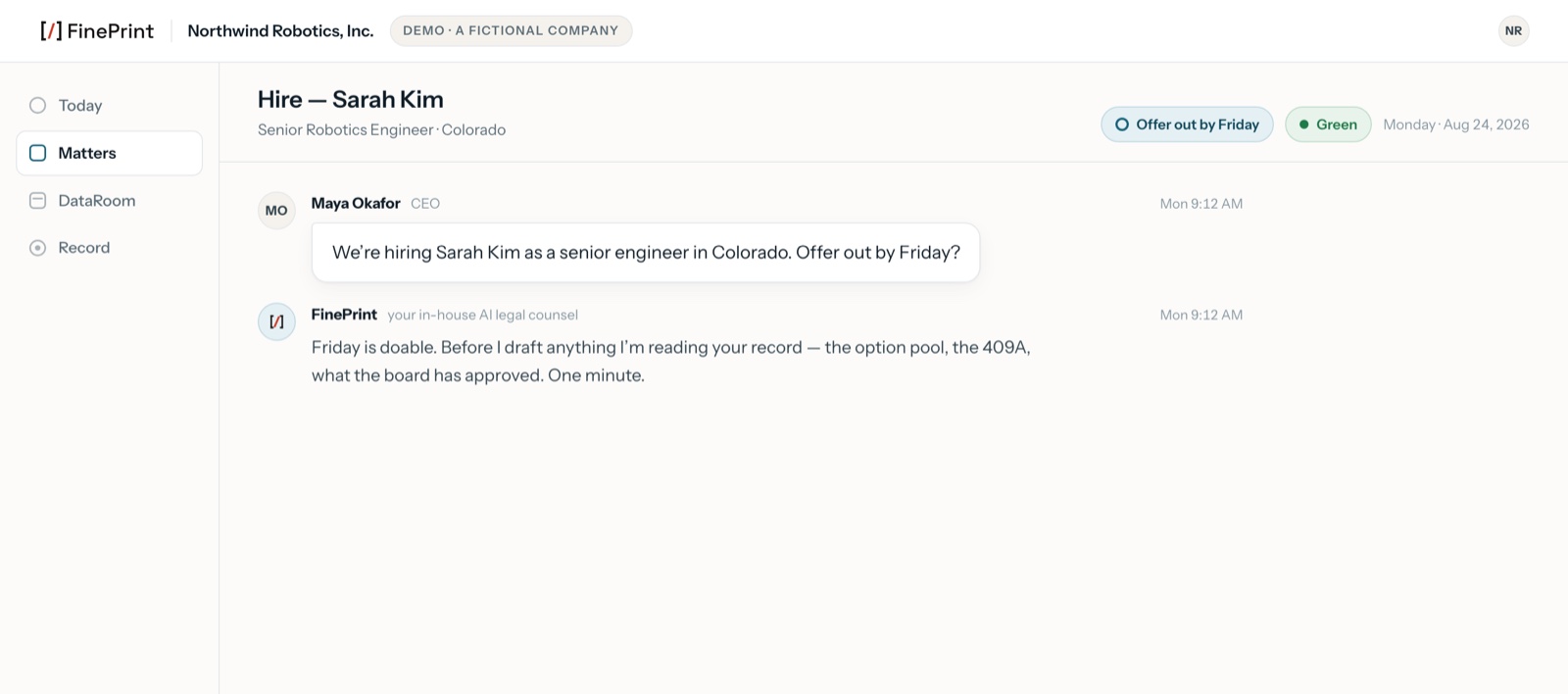
“We’re hiring Sarah Kim as a senior engineer in Colorado. Offer out by Friday?”
That sentence carries four facts and a deadline: a hire, a named person, a role, a state the company has never employed anyone in, and Friday. It is also everything Maya Okafor actually knows at 9:12 on a Monday. Nothing else is asked of her.
FinePrint answers in the same breath, and the answer is not a document. It’s a statement of what it is about to do: Friday is doable. Before I draft anything I’m reading your record — the option pool, the 409A, what the board has approved. One minute.
That order matters. A firm would open a matter and start drafting from a form. FinePrint opens the record first, because the record is what makes the draft correct rather than plausible.
The matter number — M-0847 — is assigned in the background. Maya never types it, and never needs to know it.
RUN /hire-employee
// one endpoint · the whole transaction, not a template
✓employee: Sarah Kim · senior robotics engineerfrom the question
✓work location: Colorado — new jurisdiction for this companyfrom the record
✓deadline: Fri Aug 28 — plan built backwards from itfrom the question
✓equity intended — /grant-options folded into this matterfrom the record
→reading the record9:12 AM
An endpoint is not a document generator. /hire-employee owns the documents, the board approval, the signatures, the state filings and the record update — and it will not report itself finished until all of them are done.
Scene 02
Before it drafts a word, it reads the record.
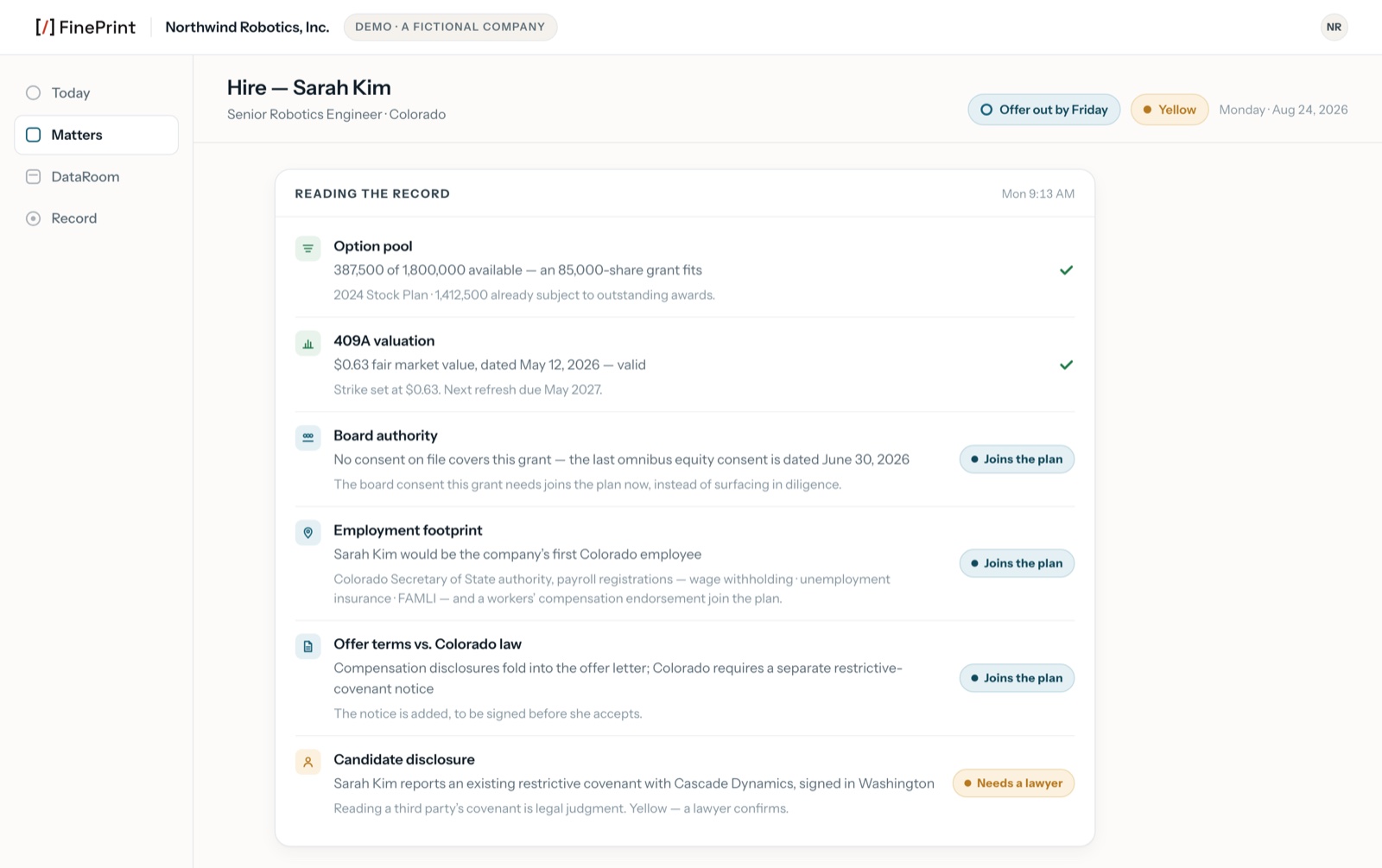
Six checks, resolved against what Northwind legally is today — not against a template’s idea of a startup. Two of them come back clean. Three add work to the plan. One stops and asks for a lawyer.
Scene 02 · Check — reading the record · Mon 9:13 AM
Six checks, with the numbers filled in.
The option pool resolves first: 387,500 of 1,800,000 shares available under the 2024 Stock Plan, with 1,412,500 already subject to outstanding awards. An 85,000-share grant fits. Green tick, no question asked.
The 409A resolves next: $0.63 fair market value, dated May 12, 2026, still valid. So the strike is not a decision anyone has to make — it is set at $0.63, and the next refresh is already on the calendar for May 2027.
Then the one that costs companies real money in diligence. Board authority: no consent on file covers this grant — the last omnibus equity consent is dated June 30, 2026 and does not reach it. So a written consent joins the plan now, rather than surfacing as a gap eighteen months later in a data room.
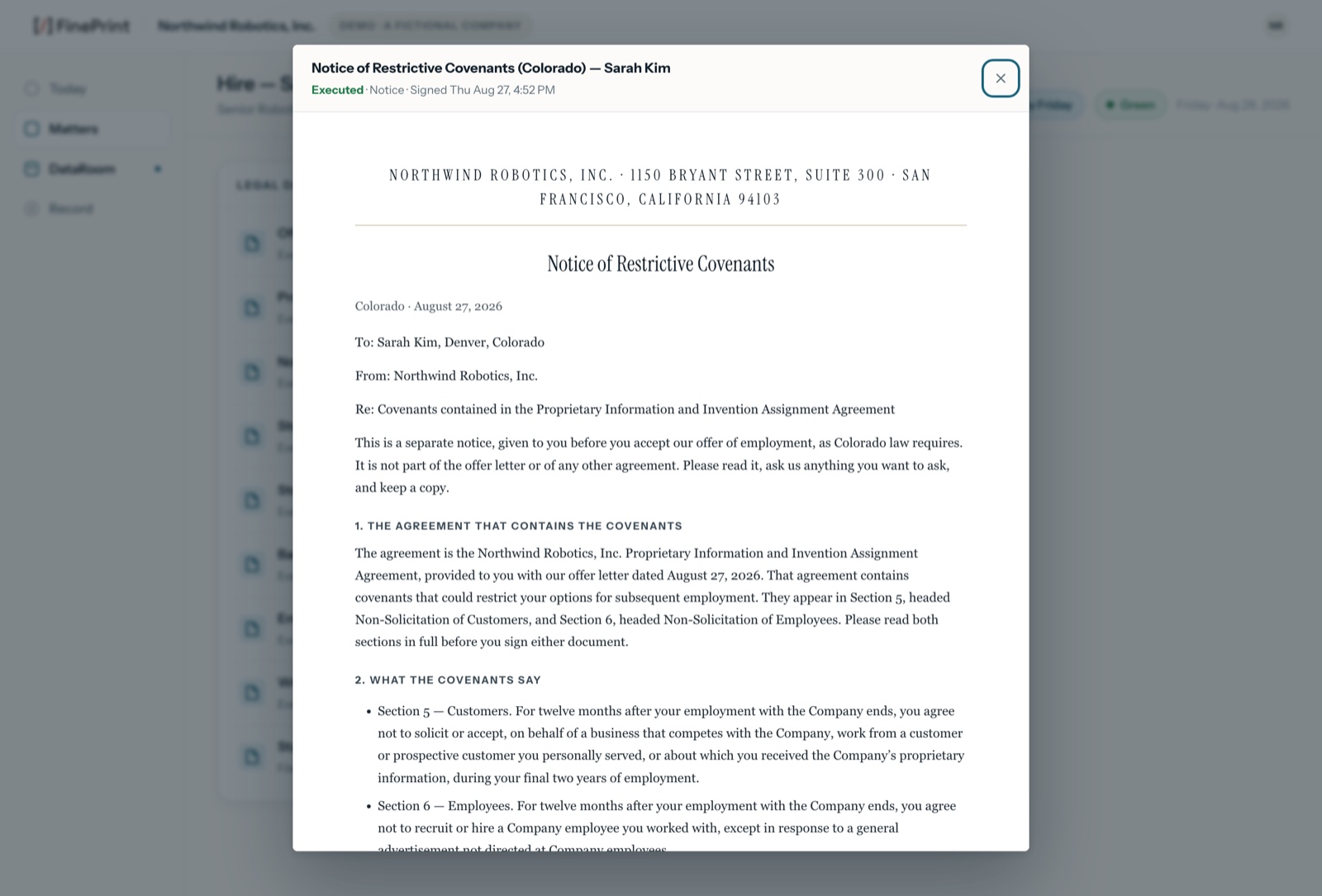
Two checks add the state. Sarah would be the company’s first Colorado employee, so a Statement of Foreign Entity Authority, three payroll registrations — wage withholding, unemployment insurance, FAMLI — and a workers’ compensation endorsement join the plan. And Colorado requires a separate restrictive-covenant notice, given before she accepts, so that is added too.
The sixth is the one a form would have swallowed. Sarah discloses an existing restrictive covenant with Cascade Dynamics, signed in Washington. Reading another company’s covenant is legal judgment. That check comes back Yellow.
Nothing on this screen was typed by a person. Every value is read from the company record, which is why the checks resolve in about a minute instead of a week of email.
Scene 02 · Check — the plan
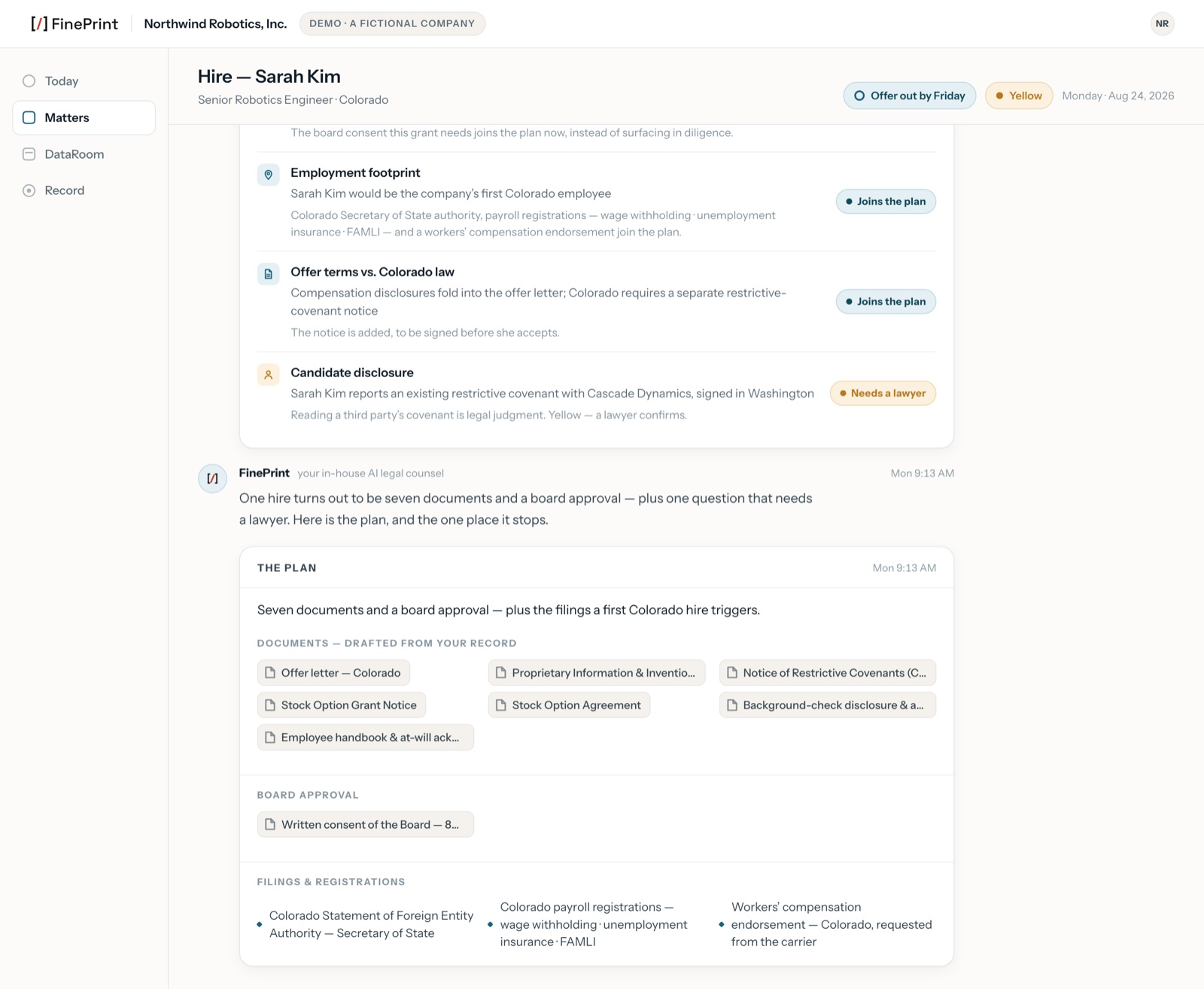
One hire turns out to be seven documents, a board approval and a set of filings.
The plan comes back as one screen with three parts, because that is what a hire actually is. Seven documents: the Colorado offer letter, the Proprietary Information & Invention Assignment Agreement, the Notice of Restrictive Covenants (Colorado), the Stock Option Grant Notice, the Stock Option Agreement, the background-check disclosure and authorization, and the employee handbook and at-will acknowledgment.
One board approval: a written consent of the board authorizing the grant — 85,000 shares at $0.63 — because the record said no existing consent covers it.
The filings and registrations: the Colorado Statement of Foreign Entity Authority with the Secretary of State, payroll registrations for wage withholding, unemployment insurance and FAMLI, and a workers’ compensation endorsement requested from the carrier.
This is the difference between an answer and coverage. Asked “can we hire in Colorado?”, an answer is yes. Coverage is the eleven other things that yes turns out to mean.
The plan is on screen before anything is drafted, and it is the plan you approve — not a surprise you receive.
The seven documents, and where each one came from
| Document | Why it is in this packet | Facts read from the record |
|---|---|---|
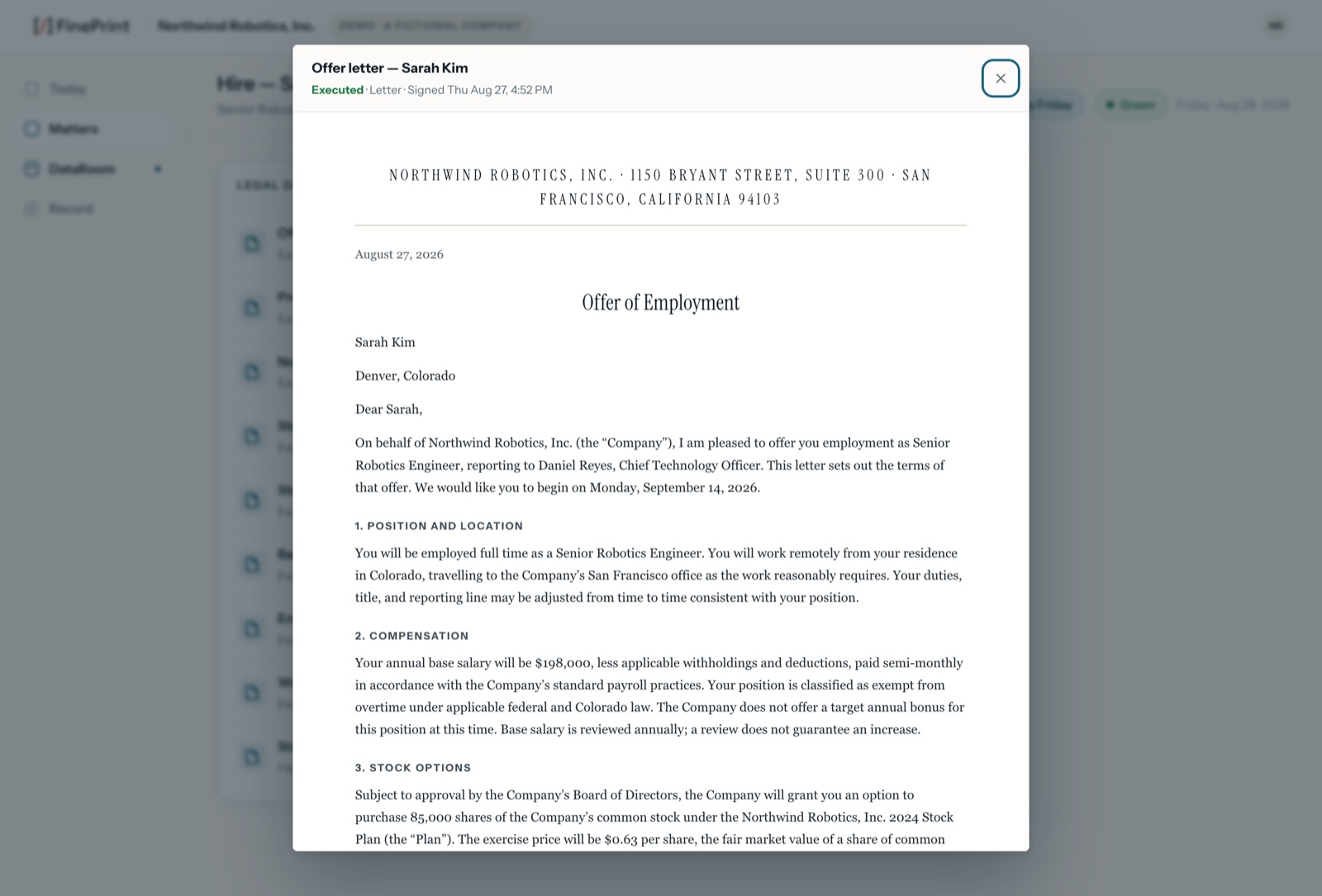
| Offer letter — Colorado | The terms of the offer, with the Colorado-specific compensation disclosures folded in. | Name · role · reporting line · $198,000 salary · start Mon Sep 14, 2026 |
| Proprietary Information & Invention Assignment Agreement | Assigns work product and sets the confidentiality and non-solicitation terms. | Company entity · standard positions · one guardrail added later by counsel |
| Notice of Restrictive Covenants (Colorado) | Colorado requires a separate notice, given before she accepts — not buried in the offer. | Jurisdiction · the covenant sections of the PIIA it must point to |
| Stock Option Grant Notice | The grant itself: how many shares, at what price, vesting on what schedule. | 85,000 shares · $0.63 strike · 4-year vest, 1-year cliff |
| Stock Option Agreement | The terms the grant runs on, under the right plan. | 2024 Stock Plan · the board consent that authorizes the grant |
| Background-check disclosure & authorization | Consent, given separately, before any check is run. | Candidate · jurisdiction |
| Employee handbook & at-will acknowledgment | The acknowledgment that makes the handbook mean something later. | Current handbook version on file |
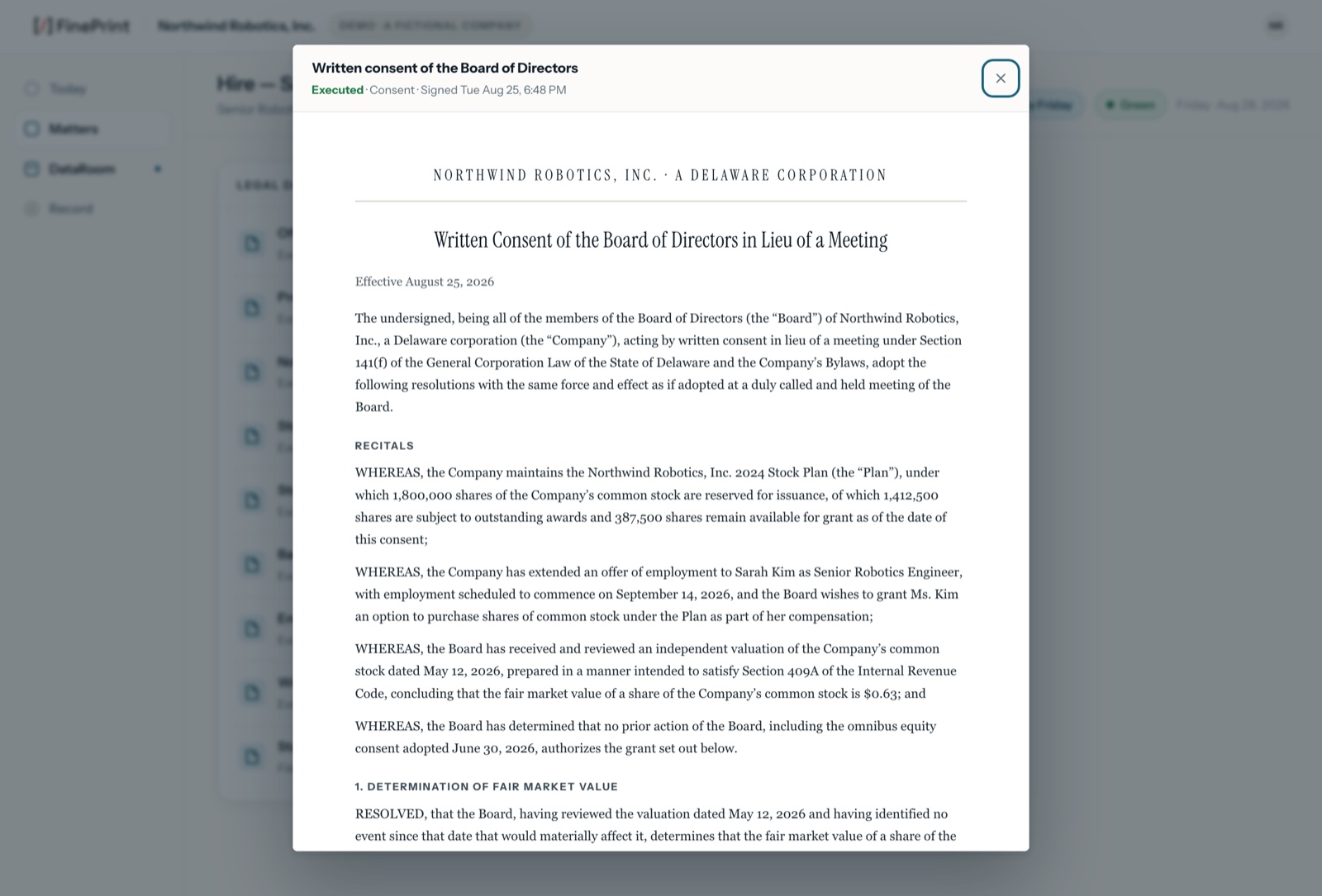
| Written Consent of the Board of Directors | Board approval of the grant — the thing the record said was missing. | Three directors · 1,800,000 reserved · 387,500 available · $0.63 valuation |
| Statement of Foreign Entity Authority — Colorado | Authority to transact business in the state you have just started employing in. | Entity details · Delaware incorporation · principal office |
Payroll registrations — wage withholding, unemployment insurance, FAMLI — and the workers’ compensation endorsement run alongside the documents and land in the record as receipts rather than as paper you sign.
The most important frame: the one it wouldn’t decide.
Five of the six checks resolved. The sixth did not, and what the system does next is the whole argument for it.
Scene 02 · Check — Yellow · Mon 9:14 AM
J. Alvarez. Employment. Colorado. No invoice.
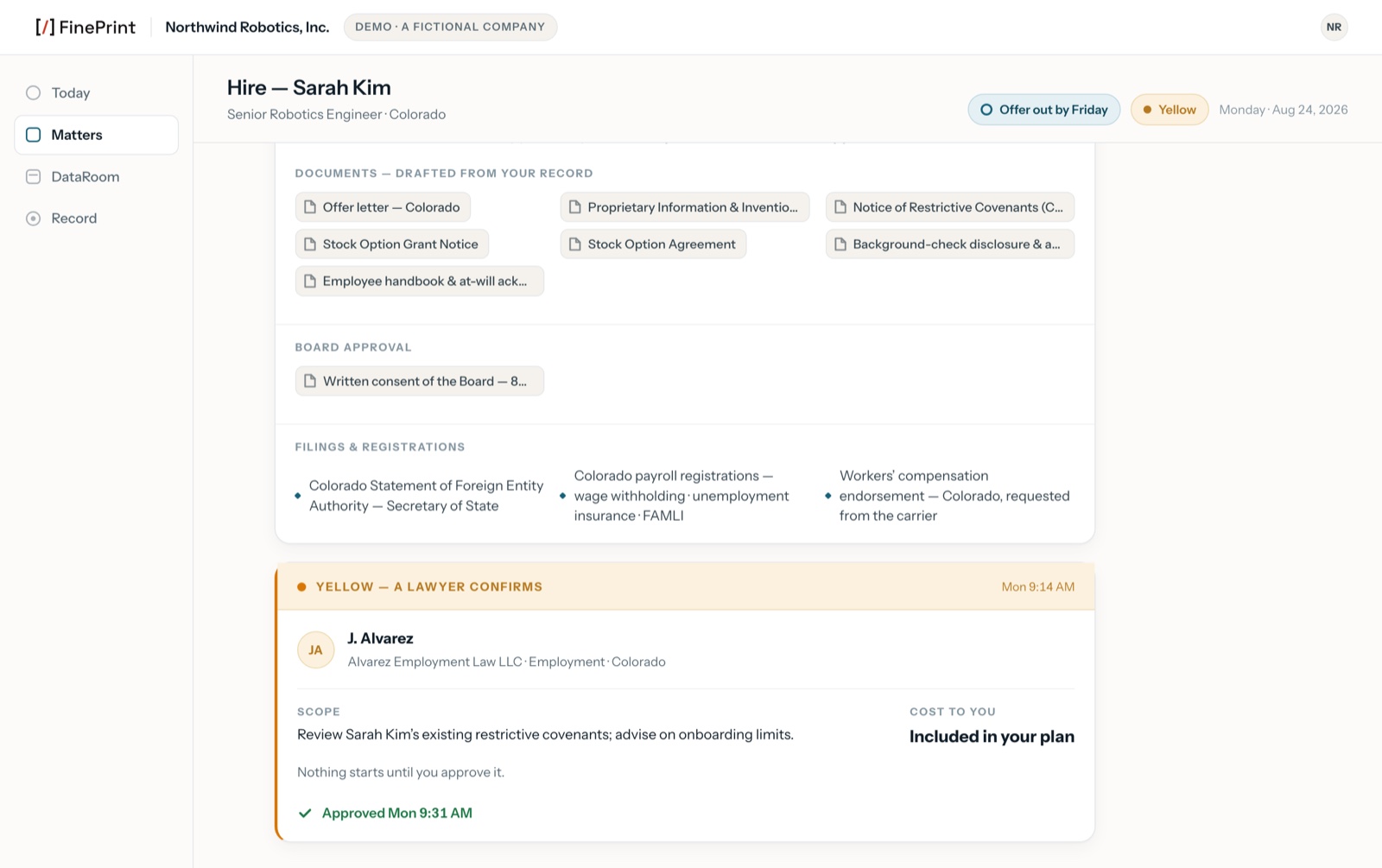
Sarah is coming from Cascade Dynamics and has an existing restrictive covenant signed in Washington. Reading it — deciding what it actually restrains, whether it bars this hire, and what Northwind must do differently on her first day — is legal judgment about a third party’s contract. FinePrint does not make that call, and it does not hedge it either.
It stops and puts a card on screen. A named attorney: J. Alvarez, of Alvarez Employment Law LLC, employment, licensed in Colorado. A written scope: review Sarah Kim’s existing restrictive covenants; advise on onboarding limits. And a cost: included in the plan — not an estimate, not a range, not an hourly rate that becomes a number later.
Then it waits. The card is dated Mon 9:14 AM and approved Mon 9:31 AM — seventeen minutes, one decision, made by Maya with the scope in front of her. In that window nothing about the covenant moved.
This is also why the rest of the packet is trustworthy. A system that never flags anything is not confident; it is unsupervised. The flag is the product working.
Every matter carries a level, and the level decides who touches it
Green — agents execute.
Five of the six checks in this matter, and every document in the packet. Standard work with complete facts runs end to end, with your approval, while the network scores the output continuously in the background.
Yellow — a lawyer confirms.
The Cascade Dynamics covenant. It sits outside what OpenLegalLM has been taught, so the endpoint stops and routes it to the network: a licensed attorney answers it before anything moves, with the attorney and the scope shown first, included in the plan — and the answer joins what the model knows.
Red — a specialist lawyer leads.
Not this matter. A financing, a dispute, a regulated question: a specialist takes it, with the record, the documents, the history and the issue list assembled before the first call.
The most important thing the system knows is when it doesn’t know. One question out of a whole week needed a lawyer — and it went to one, on a scope agreed in advance, at no cost on top of the subscription.
Scene 03
Drafted, routed, signed, filed.
Three days of work that nobody had to chase: seven drafts on Monday morning, three director signatures by Tuesday evening, counsel’s answer on Wednesday, the offer out on Thursday, the state filed on Friday.
Scene 03 · Run — the drafts · Mon 9:47 AM
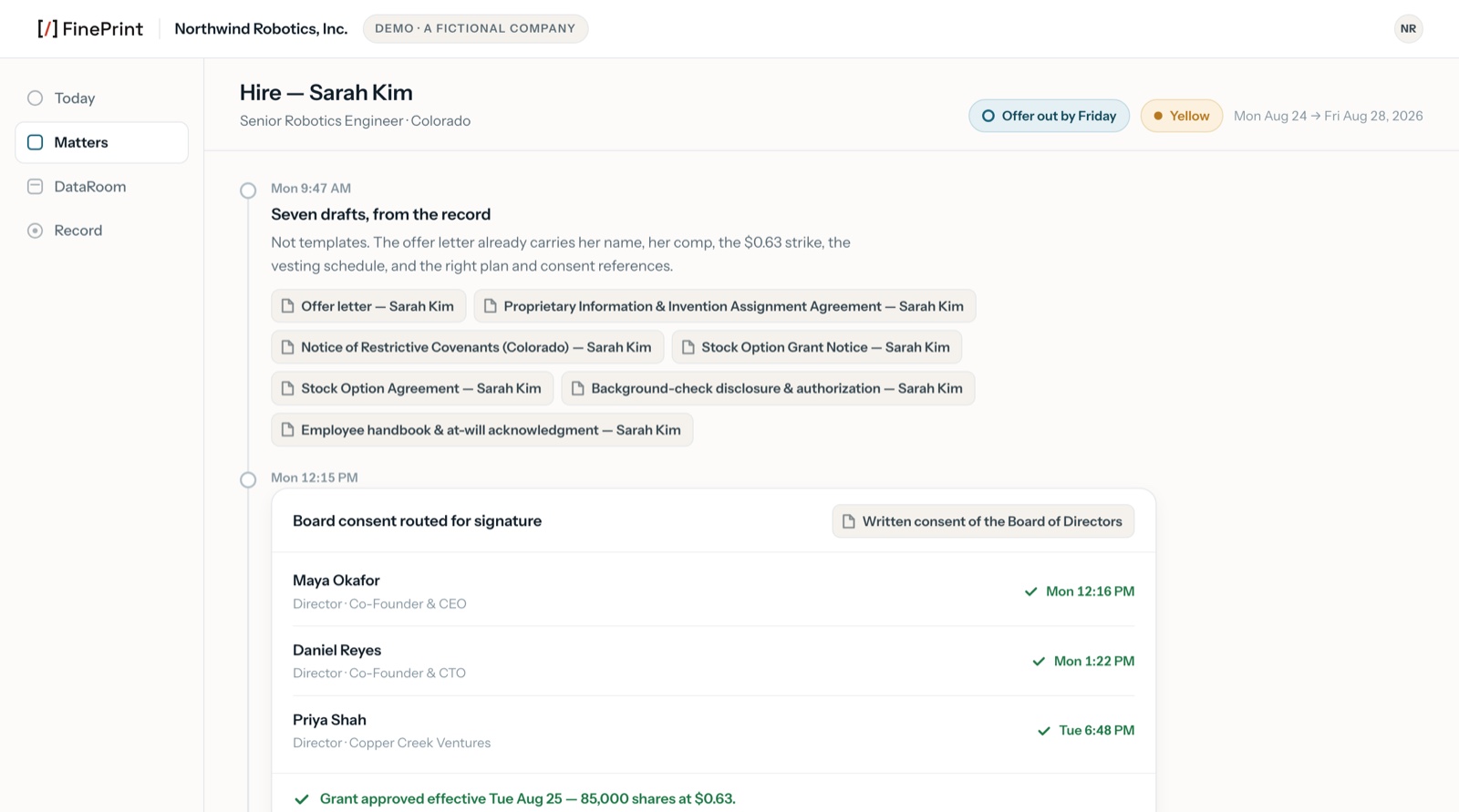
Seven drafts, from the record — not from a blank page.
Thirty-five minutes after the question, the packet exists. The offer letter already carries her name, her $198,000 salary, the $0.63 strike, the four-year vest with a one-year cliff, and references to the right plan and the right consent. Nobody merged a template. Nobody re-typed a number that was already in the company record.
At 12:15 PM the written consent is routed to all three directors. Maya Okafor signs at 12:16, Daniel Reyes at 1:22, and Priya Shah — the Copper Creek Ventures director — at 6:48 the following evening. The grant is approved effective Tue Aug 25: 85,000 shares at $0.63.
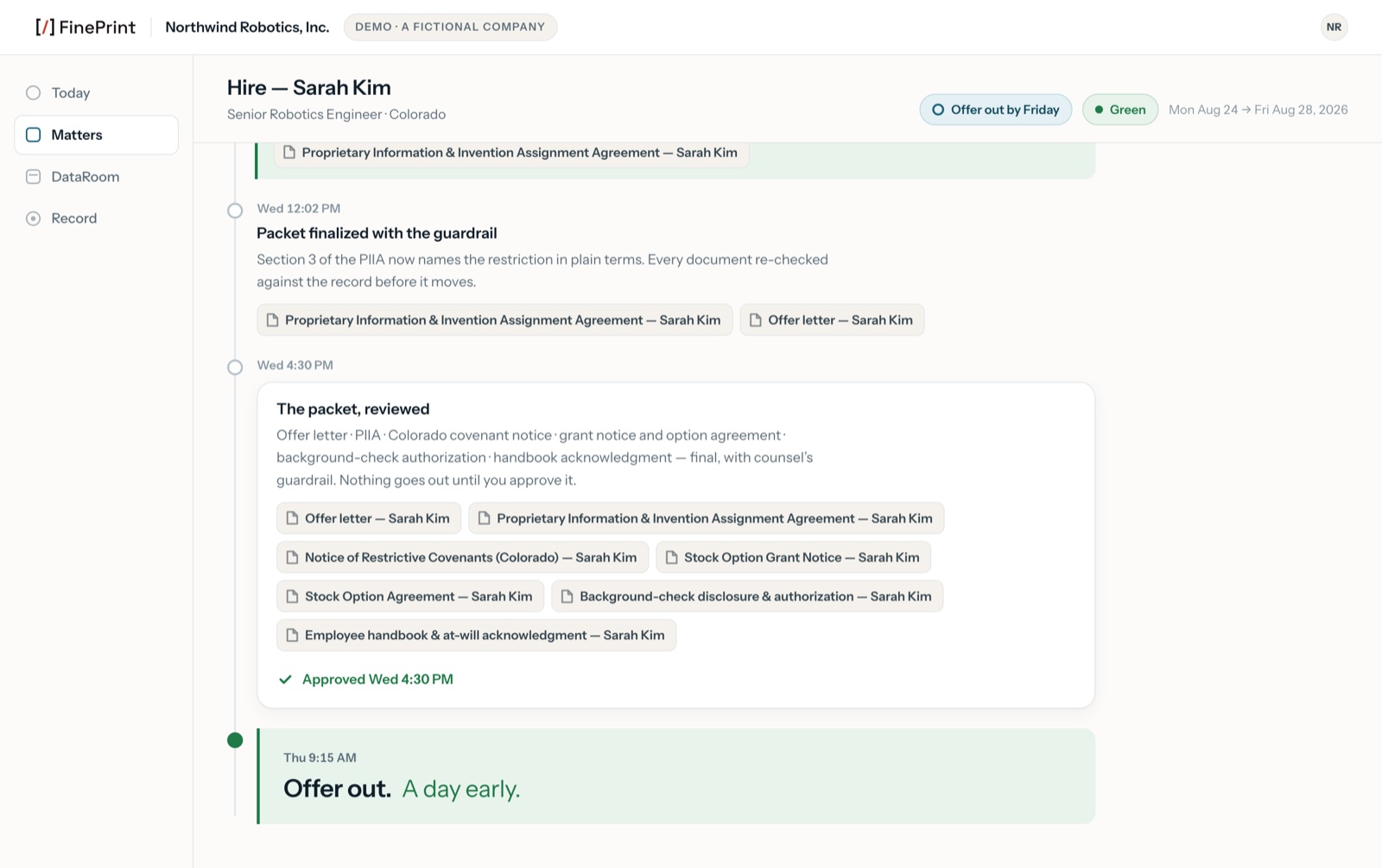
On Wednesday at 11:40 AM the covenant question comes back. J. Alvarez reads the Cascade Dynamics agreement and reports a narrow customer non-solicit, twelve months, that does not bar the hire — with one onboarding guardrail, which is added to Section 3 of the PIIA so the restriction is named in plain terms rather than left for Sarah to discover.
Yellow flips to Green. At 4:30 PM Wednesday, Maya approves the finished packet — all seven documents, re-checked against the record, with counsel’s guardrail in them.
The board consent was not an afterthought. It was in the plan on Monday morning because the record said no existing consent reached this grant.
Scene 03 · Run — offer out · Thu 9:15 AM
Offer out. A day early.
Maya asked on Monday whether Friday was possible. The offer went out Thursday morning.
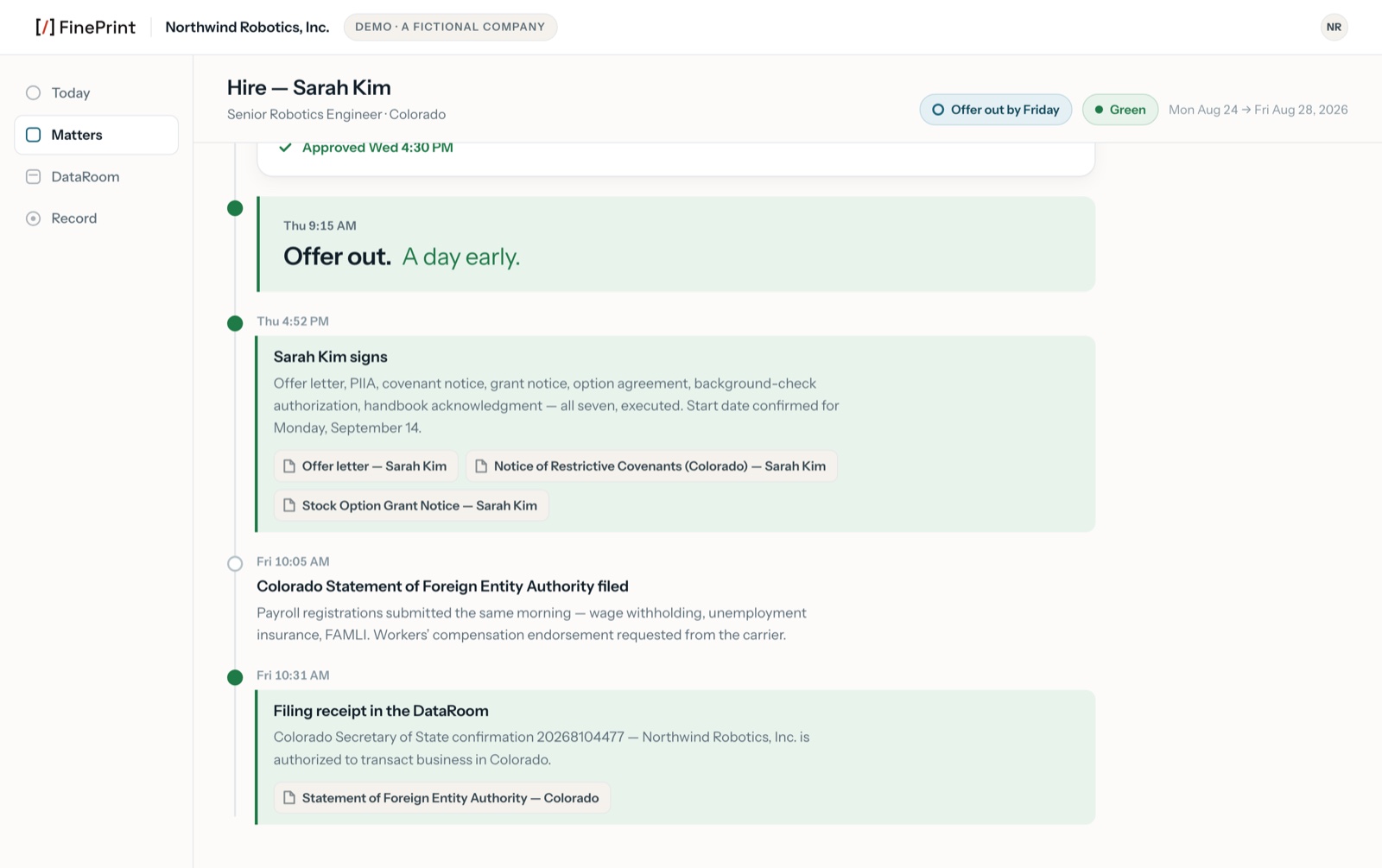
Sarah signs at 4:52 PM the same day — all seven documents executed, start date confirmed for Monday, September 14.
The deadline was not met by hurrying. It was met by knowing on Monday exactly what the week contained.
Scene 03 · Run — filed · Fri 10:31 AM
The part everyone forgets, done anyway.
A signed offer is where most hires stop being tracked. It is also where a company quietly acquires an unregistered payroll obligation in a new state.
On Friday at 10:05 AM the Colorado Statement of Foreign Entity Authority is filed with the Secretary of State. The payroll registrations go in the same morning — wage withholding, unemployment insurance, FAMLI — and the workers’ compensation endorsement is requested from the carrier.
At 10:31 the confirmation lands in the Legal DataRoom: Northwind Robotics, Inc. is authorized to transact business in Colorado. Not a note that someone should file it. The receipt.
Nobody asked for any of this. It was in the plan on Monday because the record knew Colorado was new.
Scene 04
The matter closes by changing the company.
Nine items in the Legal DataRoom, each with an executed date and a fingerprint — and, next to them, the company record already rewritten to match.
Scene 04 · Record · Fri Aug 28
Current by construction.
The Legal DataRoom holds all nine: the seven executed documents from Thursday, the board consent executed Tuesday, and Friday’s filed Statement of Foreign Entity Authority. Every one of them carries the date it was executed and a content fingerprint, so a year from now nobody has to reconstruct which version was signed.
Beside it, the company record updates itself — because the workflow that produced the documents is the same workflow that writes back. There is no separate step where someone remembers to tell the cap table what happened.
And Today carries exactly one forward item on this matter: Sarah starts Monday, September 14, with an I-9 verification reminder scheduled for her first day. Not a task somebody wrote down. A consequence the record derived.
This is what “coverage” means in practice. The matter is finished, and the next obligation it created is already on the calendar.
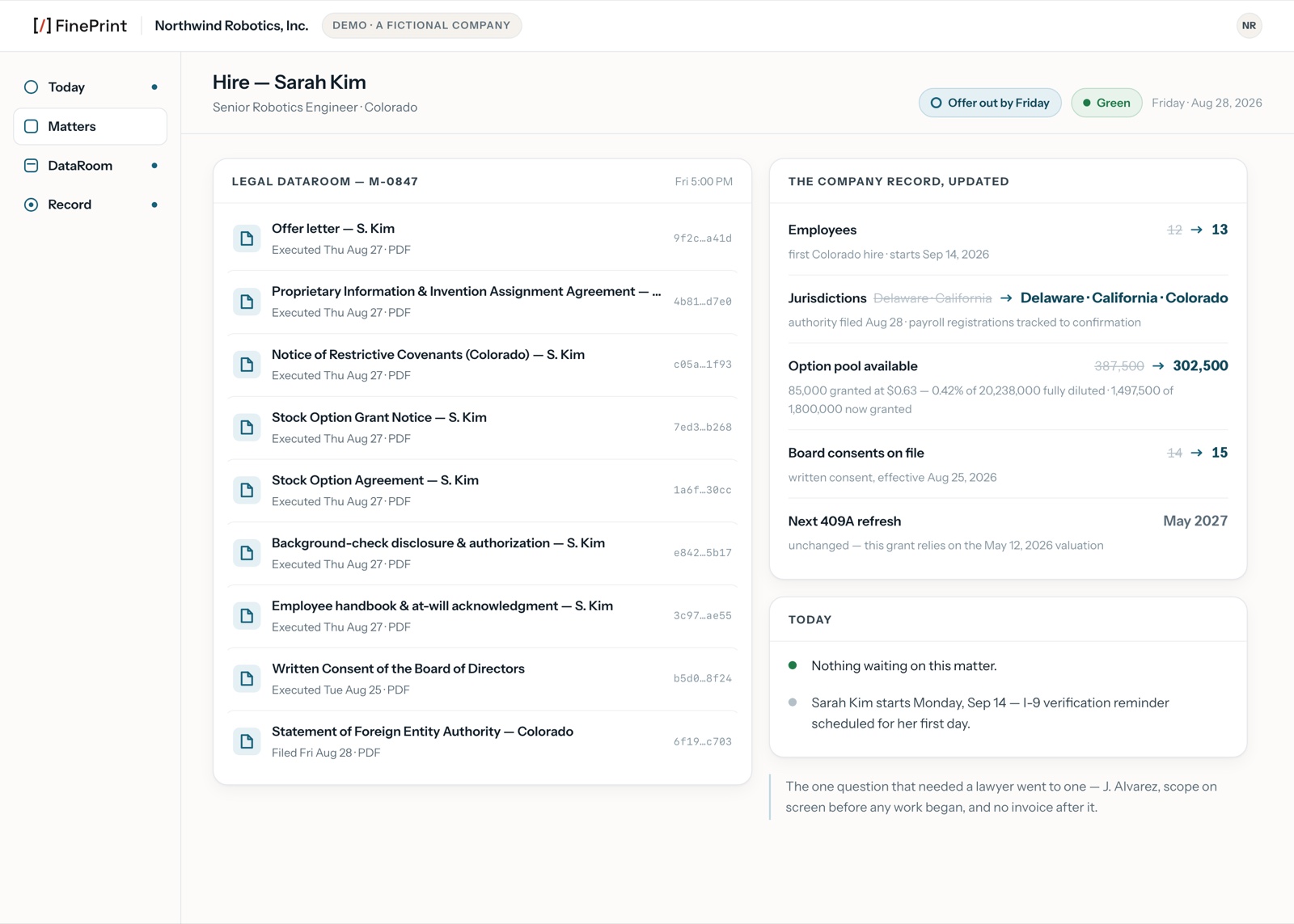
Employees · 12 → 13
First Colorado hire, starting Sep 14, 2026.
Jurisdictions · + Colorado
Delaware · California becomes Delaware · California · Colorado. Authority filed Aug 28; payroll registrations tracked to confirmation.
Option pool available · 387,500 → 302,500
85,000 granted at $0.63 — 0.42% of 20,238,000 fully diluted. 1,497,500 of 1,800,000 now granted.
Board consents on file · 14 → 15
Written consent, effective Aug 25, 2026 — indexed, not filed away.
Next 409A refresh · unchanged
May 2027. This grant relies on the May 12, 2026 valuation, so nothing about it moved the date.
Today · one item
Nothing waiting on this matter. Sarah Kim starts Monday, Sep 14 — I-9 verification reminder scheduled for her first day.
Drafted documents, not filled-in templates.
Every document in the matter opens as paper. Read them and the difference is obvious: the clauses were written for this hire, in this state, under this plan, with this board’s authority behind them.
What the week cost.
One subscription. That is the entire cost of the week — the attorney review included, and nothing billed on top of it.
1
subscription — for the company, not per seat, from $99 a month
$0
billed on top of the subscription — the attorney review is included in the plan
0
hours billed to get up to speed on Northwind’s own record
4 days
Monday 9:12 AM to the filing receipt on Friday at 10:31 AM
Now price the same week the usual way.
Email a firm on Monday. An associate reads in on the entity, the plan and the cap table — billed. Somebody drafts the packet from a form — billed. Somebody notices the board consent, or doesn’t. Somebody remembers Colorado, or doesn’t. A partner reviews — billed. The covenant question is answered inside the same hourly stream, so you never see what that specific answer cost. The invoice arrives three weeks later, measured in tenths of an hour.
We say FinePrint costs around 90% less than the retainer model, and the reason is structural rather than clever: the routine work runs as agents, the judgment comes from licensed attorneys who are paid for the judgment, and nobody bills you to get up to speed on your own company. Every plan includes credits, endpoints draw credits as they run, and attorney review is included in the plan, never billed separately. Government fees are passed through at cost.
We are not going to put a dollar figure on what a firm would have charged for this week, because we would be making it up. What we can tell you is what Northwind paid: the subscription, and the Colorado filing fees at cost. We will publish the methodology behind the 90% comparison when it is ready to be checked rather than quoted.
The same shape, forty-one times.
Everything above was one endpoint — /hire-employee. Forty more run exactly this way: read the record, build the plan, flag what needs judgment, draft, route, sign, file, write back.
Formation 4 · Governance 6 · Hiring 6 · Equity 6 · Fundraising 5 · Commercial 6 · IP 4 · Compliance 4. Behind them, six specialist agents — Commercial, Employment & HR, Corporate, Privacy, data & AI, IP & brand, and Compliance & risk — working the same record.
Your company’s week looks nothing like this one.
Start with what’s already true about yours.
Run the free Legal Health Check. Connect the documents you already have; in about four minutes you get one score and the exact list behind it — missing, doesn’t match, due soon — and the first version of your company record.
Find my legal gaps — freeOr read the parts underneath this walkthrough: the agents that run the endpoints, the record that makes them correct, and what it costs at your stage.
Talk to usThe agents
Six specialists, forty-one endpoints, one record. Agents
The Legal DataRoom
Every signed document, indexed and diligence-ready. Legal DataRoom
What it costs
Five plans, for the company, from $99 a month. Solutions & pricing